Binchotan cooking means grilling over Japanese white charcoal, a dense, nearly smokeless fuel that burns hot and steady for hours and lets the food taste of itself. It suits fast, high-heat cooking such as skewers, fish and thin cuts of meat, and it asks for patience, because it is slow to light and unforgiving if you rush it. Below you will find what binchotan is, how it is made, how to light and control it, what to cook on it and how to put it out safely.
TL;DR
- Binchotan is hardwood charcoal, traditionally made from ubame oak, with about 95% carbon against roughly 75% for ordinary lump charcoal.
- It burns for around four to five hours with almost no smoke or added flavor, which is why yakitori cooks prize it.
- Light it outdoors in a chimney starter or over a burner. Plan on 10 to 45 minutes depending on the method, and never put water on hot coals.
- It is built for fast, hot cooking. Low and slow barbecue is the wrong job for it.
- Fire is a technique, not a gimmick: at Aflamas in Barcelona we cook with live fire as part of our tasting menus.
Table of Contents
- What binchotan is and how it is made
- How binchotan differs from ordinary charcoal
- What binchotan is good for
- The konro: the grill made for binchotan
- How to light binchotan safely
- Controlling the heat
- Putting it out and storing it
- Why chefs care about fire
- Our perspective on fire in the kitchen
- Taste fire cooking at Aflamas in Barcelona
- Buying binchotan: what to look for
- A simple first cook
- FAQ
- Sources
What binchotan is and how it is made
Binchotan is a white charcoal. The best-known version, Kishu binchotan, is made from indigenous ubame oak. According to BBC Travel, the wood is baked at low temperatures, then the kiln temperature is raised rapidly and oxygen is restricted to protect the carbon. Ash is then used to cool the charcoal, which gives it its pale, whitish surface.
The process is slow. Food & Wine describes craftsmen firing oak branches at very low temperatures for about a week, refining them above 1,000°F for one to two days, then covering the charcoal with sand and ash so it cools slowly. The same article puts binchotan at about 95% carbon, against roughly 75% for ordinary lump charcoal.

That density explains almost everything about how it behaves. Epicurious quotes chef Tadashi Ono attributing its performance to extremely hard charcoal produced by roughly a week of firing in an earthen kiln. Hard charcoal burns slowly, evenly and cleanly.
You will see “binchotan” sold at many price points, and not every product is the same. Kishu binchotan from Wakayama is the benchmark. Others are made from different oaks or in different kilns, and they vary in density, burn time and how much they spark. A heavy, hard piece that rings slightly when tapped is usually a better sign than one that crumbles.
How binchotan differs from ordinary charcoal
Three things set it apart: heat, cleanliness and duration.
Heat. Serious Eats describes binchotan as an exceptionally clean-burning charcoal that produces infrared heat around 1,200°F, which makes it particularly suited to high-heat searing. A report in Deia, on binchotan arriving in San Sebastián kitchens, gives a professional cooking range of roughly 800 to 1,000°C.
Cleanliness. Epicurious notes that binchotan adds virtually no flavor or aroma of its own, unlike briquettes or smoky hardwood lump. The food keeps its own taste. A Serious Eats guide to the konro grill adds that its virtually smokeless burn can give an intense char without hiding delicate flavors.
Duration. Epicurious reports that good Kishu binchotan typically burns for four to five hours and can be extinguished and reused. That is a real saving over a bag of briquettes, which is part of why serious home cooks accept the higher price.
| Binchotan | Ordinary lump charcoal | Briquettes | |
|---|---|---|---|
| Carbon content | About 95% | About 75% | Varies by brand |
| Smoke and flavor | Almost none | Smoky, wood character | Often a chemical or binder note |
| Burn time | About 4 to 5 hours | Shorter | Moderate |
| Best for | Fast, hot grilling | General barbecue | Convenience |
| Time to light | 10 to 45 minutes | Fast | Fast |
The carbon figure comes from Food & Wine and the burn time from Epicurious, both cited above. The other cells are general characteristics rather than measured values.
What binchotan is good for
In short: hot, quick, precise cooking. That is why it is the fuel behind yakitori, the Japanese chicken skewers grilled in small, focused batches. Because the heat is intense and the smoke minimal, chicken skin crisps while the meat stays juicy, and the flavor stays clean.

Mitsuo Okazaki, a Kishu binchotan maker, told BBC Travel he recommends wagyu, lamb, yakitori and salted mackerel, and says mackerel in particular reveals the charcoal’s subtle aroma. Serious Eats says meat and vegetables both work, either on skewers or directly on the grate, and that dripping fat can add a charbroiled note.
Good candidates:
- Chicken thigh, skin and offal on skewers.
- Oily fish such as mackerel or sardines, salted beforehand.
- Thinly sliced beef, lamb chops and pork belly.
- Shrimp and squid.
- Vegetables with some moisture and sugar: leeks, eggplant, shiitake, peppers.
- Rice balls brushed with soy, for a crisp crust.
Bad candidates are the dishes that need gentle heat. Serious Eats cautions that binchotan is meant for fast, hot cooking and is poorly suited to low-temperature work, because its intensity can dry food out. If you want a four-hour brisket, use something else.
The konro: the grill made for binchotan
Binchotan is traditionally burned in a konro, a compact Japanese grill with a body of diatomaceous earth. As Serious Eats explains, that material distributes and holds heat, and with binchotan the grill cooks at high heat using infrared radiation. A long, narrow konro also suits skewers, which rest across the open top.
You can burn binchotan in other grills, including a kamado or a sturdy kettle, and many cooks do. A konro is simply designed for it: small footprint, side vents for airflow, and a grate close to the coals. If you use another grill, make sure it can take very high temperatures and that you can place the charcoal in a compact bed.
How to light binchotan safely
This is the part that frustrates beginners. Binchotan is dense, so it does not catch like ordinary charcoal. Light it outdoors, always.
Method 1: chimney starter
This is the method Serious Eats recommends: put crumpled newspaper beneath the logs in a chimney starter and wait about 10 to 15 minutes, until the charcoal is completely white and hot. Then use tongs to arrange the burning pieces in the grill.
Method 2: chimney with ordinary charcoal
Epicurious describes a slower route: start ordinary charcoal in a chimney, add binchotan on top, and allow about 30 minutes for the logs to glow. A cast-iron starter over a butane burner takes about 20 to 30 minutes.
Method 3: patience
The My Cookware konro guide suggests allowing 30 to 45 minutes. It advises standing the pieces vertically in a chimney, turning them at about 15 minutes and moving them only when they are red-hot and coated with white ash.
The range across sources, from 10 to 45 minutes, is normal. It depends on the piece size, how dry the charcoal is and how much airflow you give it. Do not judge by color alone: wait for the white ash coating and a deep glow.
Safety while lighting
- Keep binchotan dry. My Cookware warns that damp pieces can pop and throw fragments, so handle them cautiously when lighting.
- Use the grill outdoors in well-ventilated conditions, on a stable, heat-resistant surface, away from flammable materials. Never leave it unattended.
- Use long tongs and heat-resistant gloves. Binchotan can look inert on the outside while it is glowing within.
- Keep children and pets away from the grill and from stored charcoal.
If you live in an apartment in Spain, check your building rules and local fire regulations before lighting anything on a balcony. Many communities of owners ban open flames on terraces, and wildfire restrictions apply in many regions in summer. Your town hall or the regional fire service is the authority to ask.
Controlling the heat
Binchotan does not have a dial, so you control it with airflow and layout.
- Vents. On a konro, opening the side vents increases airflow and heat, and closing them reduces both, as Serious Eats explains.
- Charcoal layout. Stack the pieces in a log-cabin pattern for airflow, or load them two to three pieces deep only under the zone you plan to use. That leaves a cooler side for resting food.
- Distance. The Deia report says professional cooks modulate binchotan by changing the distance of the product, the charcoal load, the grill height and the air management.
- Two zones. Keep a hot side for searing and a cooler side for finishing. The same idea that a yakitori cook uses to crisp skin first and cook through gently after.
Work quickly and stay close. At these temperatures the difference between a perfectly charred skewer and a burned one is a matter of seconds.
Putting it out and storing it
One advantage of binchotan is that it can be reused. The way you put it out matters.
- Let the coals burn out and cool completely in the grill, or move them with tongs into a covered, fireproof container.
- Never throw water on the coals. Serious Eats warns that the sudden change in temperature can crack the grill.
- Once fully cold, store the leftover pieces dry, in a cool place, out of children’s reach.
Reused pieces light faster the second time, since they have already been through the fire.
Why chefs care about fire
The appeal of binchotan is the same as the appeal of any good live-fire cooking. You get a flavor you cannot reproduce in a pan or an oven, and you get speed and control from someone who knows the fire. It is also a reminder that fuel is an ingredient. A cook who chooses a clean-burning charcoal is deciding how much smoke the dish should carry.
That tradition is not only Japanese. Spain has a long culture of cooking over embers, from the grill rooms of the Basque Country to the calçotada in Catalonia. The Deia article shows how Japanese charcoal has found its way into Basque kitchens precisely because it fits that appetite for clean, direct fire.
A Japanese table also has its own quiet counterpoint to smoke and char. A cup of roasted hojicha tea after a grilled meal is a classic way to finish, since its toasted notes echo the fire without any heaviness.
Our perspective on fire in the kitchen
At Aflamas, fire is how we think about cooking. Our cuisine combines modern technique with live fire and local, seasonal products, and the lesson we take from traditions like binchotan grilling is simple: the cleaner and more controlled the fire, the more the ingredient has to say.
We would add three points from our own experience of cooking with flame:
- Fuel is a decision. Whether a cook wants smoke, a neutral heat or a long glowing bed changes what lands on the plate. Treat it as seriously as the choice of fish or cut.
- Heat management is the craft. The fire itself is the easy part. Knowing where to place the product, how long to leave it and when to pull it is what takes years.
- The best ingredient needs the least interference. A fresh, local product cooked over the right heat with a little salt often beats an elaborate sauce.
These are the ideas behind how we build our menus, and you can read more on our page about live fire cooking for diners. If you are curious about the format itself, our guide to the tasting menu explains how the courses are paced.
— YellowRock
Taste fire cooking at Aflamas in Barcelona
If you would rather eat food cooked over fire than learn to light it, you can do that with us. Our tasting menus are built around contemporary, chef-driven cooking with fire and local products, and we adapt every menu for vegetarian, vegan, gluten-free and lactose-free diners.
The Menú Selección Autor is €90 per person and is our signature format. For a bigger occasion, the Menú Festival is €150 per person. If you want something shorter, the Menú Temporada is €60 per person and the Menú Ejecutivo is €35 per person.
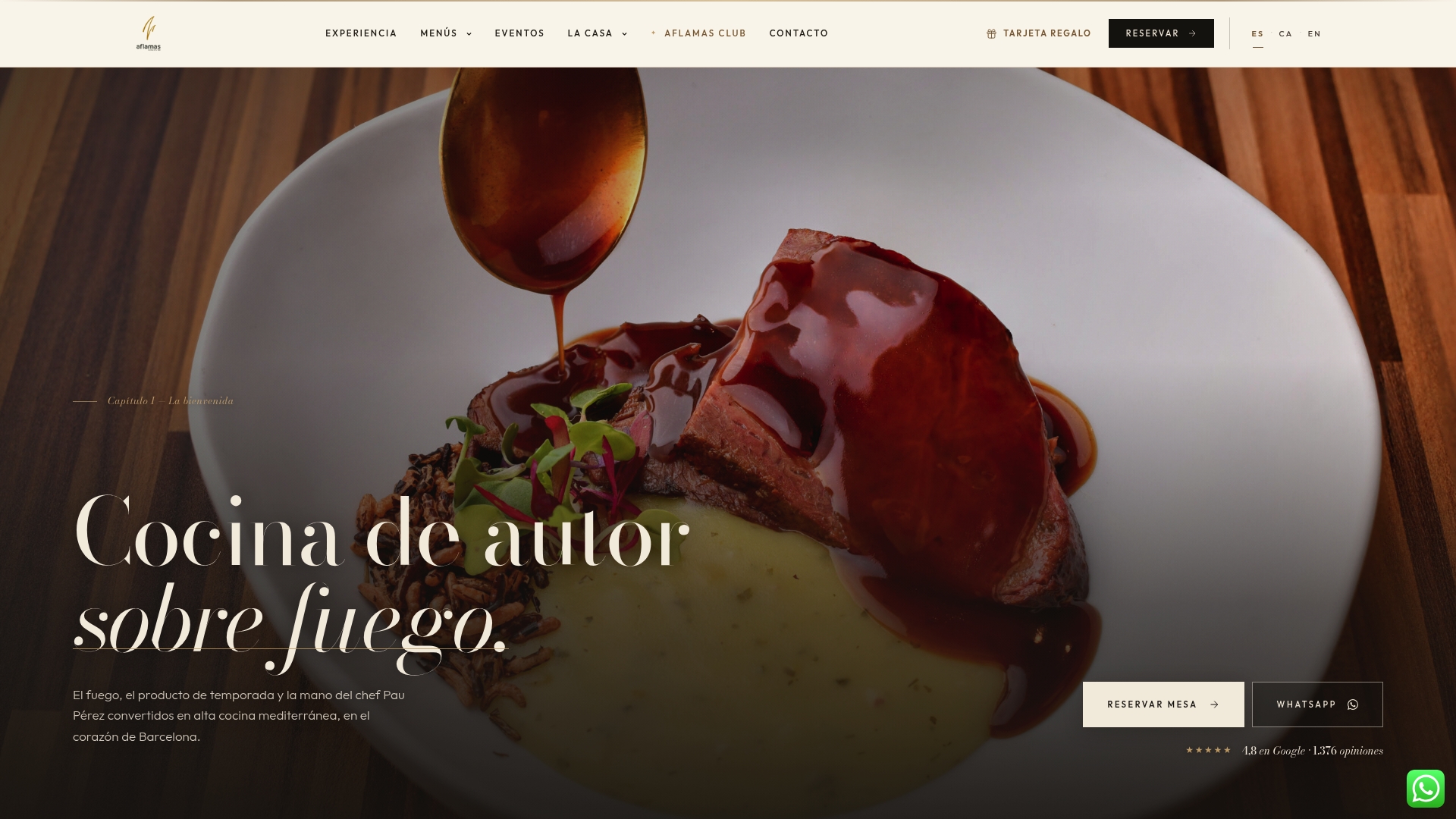
Booking for a group or a private celebration? The Alma, Fuego and Pasión group menus start at €45, €65 and €95 per person respectively, and our private dining rooms give your table real privacy. You can also give the experience to someone else with a gift card.
Buying binchotan: what to look for
If you decide to try it at home, a few points will save you money and frustration.
- Check the origin and the wood. Kishu binchotan from ubame oak is the reference. Cheaper products may be made from other woods and burn differently.
- Buy by weight and piece size. Whole logs last longer and are easier to arrange. Fragments burn out sooner.
- Plan for a chimney starter. It is the single most useful accessory, and it is what the sources above recommend.
- Match it to your grill. A konro or a grill with a compact, deep charcoal bed will use binchotan efficiently. A wide, shallow grill wastes heat.
- Keep it dry. Store it in a sealed container in a cool, dry place.
Expect to pay more than for ordinary charcoal. The case for it is that it burns for hours, gives off almost no smoke and can be reused, so the cost per cooking session is lower than the sticker price suggests.
A simple first cook
If you want a low-risk way to start, try chicken thigh skewers.
- Cut boneless thigh into bite-size pieces and thread them onto skewers, keeping the pieces the same size.
- Salt them lightly about 15 minutes before cooking.
- Light the binchotan in a chimney outdoors until it is white and glowing, then arrange it in a compact bed on one side of the grill.
- Grill over the hot side, turning often, until the skin colors and the juices run clear.
- Move the skewers to the cool side for a minute to rest, then serve with lemon or a brush of tare.
The entire cook takes minutes, but the preparation takes the better part of an hour. That is the rhythm of binchotan: long start, fast finish.
FAQ
What is binchotan charcoal?
It is a dense Japanese white charcoal, traditionally made from ubame oak and fired in a kiln for about a week before being cooled in ash and sand. It is about 95% carbon, burns hot and nearly smokeless, and lasts around four to five hours.
What is a binchotan grill?
Usually it means a konro, a small Japanese grill with a diatomaceous-earth body and adjustable side vents, designed to hold the charcoal close to the food. You can also burn binchotan in other grills that handle very high heat.
How long does binchotan take to light?
Between about 10 and 45 minutes depending on the method. A chimney starter with newspaper can take 10 to 15 minutes, while slower methods take 30 to 45 minutes. It is ready when the pieces are glowing and covered in white ash.
Can I use binchotan indoors?
No. Light and use it outdoors in a well-ventilated place, on a stable heat-resistant surface, away from anything flammable, and never leave it unattended. If you only have a balcony, check your building rules and local fire regulations first.
Can binchotan be reused?
Yes. Let it cool completely in the grill or transfer it with tongs to a covered, fireproof container. Never use water. Once cold and dry, store it and use it again.
Sources
- The secret to Japanese grilling, BBC Travel
- Why chefs call this Japanese charcoal the best in the world, Food & Wine
- Binchotan charcoal is your summer grilling splurge, Epicurious
- What Are the Different Types of Charcoal?, Serious Eats
- What Is a Konro Grill?, Serious Eats
- El carbón Binchotan, desde Japón a Donostia, Deia
- Japanese Konro Grill user guide, My Cookware