Tasting Menu.
Twelve or thirteen courses. No list, no spoilers. The team picks every dish each day based on the market, the fish market and Pau's instinct. A sensory journey guided by fire that never unfolds the same way twice.
The menu you cannot read.
A fixed menu limits the cook. The Tasting Menu does the opposite: you trust him and, in return, he takes you where you wouldn't reach on your own.
The Tasting Menu has no list and never will. It's a decision, not an oversight. When a cook knows in advance every dish he's going to serve, cooking turns mechanical: predictable produce, repeated technique, surprise impossible. But when the menu is built each morning around what comes through the fish market door, what arrives from the garden, what the day calls for, the table becomes something alive.
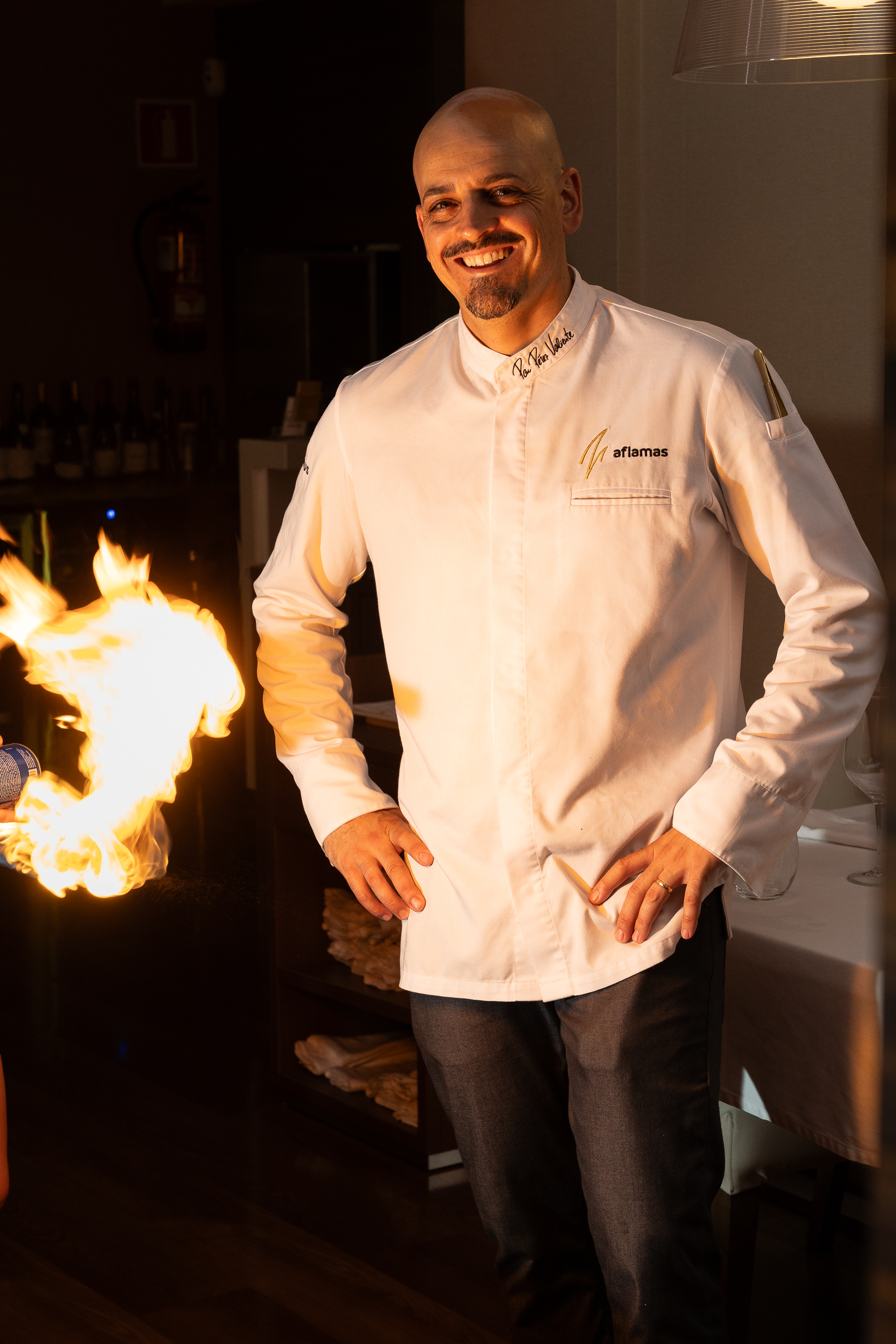
Pau and his team go down to the market every day. They choose the fish, the mushrooms, the vegetables, the aged meats that are at their precise peak. Then they build the menu around that produce, not the other way round. That's why the Tasting Menu changes every service. That's why we can't promise you what you'll eat. And that's why we can promise you something more important: nothing reaching your table will be below its best moment.
The structure is always the same: we open with cold, delicate bites, move through the cooking techniques —live fire, low temperature, fermentation—, build towards the heartier courses and close with two or three sweet ones. The progression is deliberate. What changes is the content: one week there may be red prawn from Palamós, the next goose barnacles from Galicia, the next langoustines from Llançà. The judgement is the same, the dish is different.
The Tasting Menu lasts between two and a half and three hours. We recommend it for a single table per night and per service where possible: it asks for focus, an alert palate, and the slow conversation that only appears over a long dinner. It isn't a menu for a quick break. It's a menu for devoting a whole evening to the experience.
If you have allergies or intolerances, we need to know at least 48 hours in advance. We adapt the entire menu; we don't improvise on the spot. If you'd like a pairing, our sommelier designs a selection of wines and other drinks to accompany each course. Ask about the wine pairing when you book: the supplement depends on the type of selection.
No list, but judgement.
We can't tell you what you'll eat. But we can tell you how it will be conceived. Six principles that govern every Tasting Menu, whatever the produce, whatever the night. Your quality guarantee when you book blind.
Produce always rules.
The menu is built each morning, not the night before. Pau and his team go down to the Barcelona fish market, the wholesale market and the aged-meat suppliers. What is seen is tasted, and what is tasted is bought. If a piece doesn't convince, it doesn't make it in. If something exceptional turns up outside the plan, it's added. The day's menu closes when they get back to the kitchen.
The menu is closed two hours before serviceFire is the lead.
Most courses pass over the embers: marabú and holm oak charcoal. Marabú —a Cuban charcoal of extremely high density— gives a stable, long-lasting ember at very high temperature; holm oak adds a Mediterranean aromatic profile and tempers the smoke. Cooking over embers allows no shortcuts: you have to stand before the fire, reading the produce every second. It's the technique that defines Aflamas and the one most felt in the Tasting Menu.
Not every course is over embers, but fire directs the menuNo repetition.
Each technique appears only once. If we open with a raw fish dish, there won't be another raw one. If we serve a rice, there won't be another spoon dish on a similar base. The menu is designed so your palate never settles into the familiar: each course is a surprise of texture, temperature or concept unlike the one before.
Twelve or thirteen courses, twelve or thirteen distinct ideasAscending order.
We begin with the most subtle: cold bites, marine minerality, vegetables at their peak. Then the warm techniques come in, the hot courses, and we close with the heartiest main of the day. Afterwards, two or three sweet courses that bring the intensity down little by little. It's a narrative arc, not a succession of dishes.
From lower to higher intensity, with no abrupt jumpsAdaptable to your table.
The table sets the pace, not the kitchen. If a table wants to go slower, we go slower. If it needs to wrap up sooner for other plans, we adjust. The front-of-house team reads each guest and signals the kitchen. For allergies and restrictions, the entire menu is rewritten: it's never improvised on the spot. We need 48 hours to do it properly.
Allergies and intolerances 48 h in advanceOptional pairing.
Our sommelier prepares a selection of drinks to accompany each course: wines from small wineries, ferments, infusions, the odd alcohol-free surprise. The pairing is designed once the day's menu is set, so it too is unique. The supplement depends on the type of selection you prefer.
Ask the sommelier when you bookSix principles. Zero concrete promises, one hundred per cent judgement. What you book is the Tasting Menu, not twelve dishes. What you receive is Aflamas's cooking in its freest form.
Book ahead.
The Tasting Menu isn't for an improvised dinner. We need to know in good time that you're coming so we can prepare the menu, organise the dining room and, if you ask for it, the wine pairing. Before you book, it's worth being clear on this:
Tasting Menu
12—13 surprise courses · Marabú embers · 2.5—3 h · Optional pairing
Looking for something different? We have five more menus: Lunch Menu (€35), Seasonal Menu (€60), Signature Selection (€90), Groups and our à la carte. See the full offer →