Live fire cooking, in a fine-dining context, means chefs use open flame, embers, and smoke as primary cooking techniques throughout a tasting menu, not just for one showpiece course. It suits diners who want technical, sensory-driven meals and don’t mind a longer, multi-course commitment. It’s a poorer fit for anyone sensitive to smoke or unwilling to sit through 90 minutes or more at a table. Most kitchens working this way can still adapt courses for major dietary restrictions.
TL;DR:
- Chefs use a variety of fire techniques, including searing, ember cooking, smoking, torches, and ash contact, to achieve specific flavor and texture outcomes.
- Wood choice and placement directly influence the intensity and character of the fire, with custom setups allowing precise control over cooking results.
- Proper ventilation, safety protocols, and staff training are essential for safety and comfort in live fire kitchens, especially during long tasting menus.
- The sustainability of wood and charcoal sources is increasingly important, with responsible sourcing and farm waste repurposing becoming standard practice.
- Bookings often require advance planning, with specific questions about seating, course length, dietary adjustments, and safety considerations to ensure a tailored experience.
Table of Contents
- What to Expect at a Live Fire Tasting-Menu Dinner
- How Chefs Use Fire on a Tasting Menu
- How to Choose and Book a Live Fire Tasting-Menu Restaurant
- Dining Comfort, Etiquette, and What to Wear
- Safety Measures and Precautions in Live Fire Cooking Environments
- Traditional and Modern Live Fire Cooking Techniques Around the World
- Equipment and Tools Essential for Live Fire Cooking
- How Fire Changes Flavor and Texture at a Chemical Level
- Environmental and Sustainability Considerations for Fuel Sourcing
- How Aflamas Approaches Live-Fire Tasting Menus
- Book the Aflamas Tasting Menu
- Sources
- FAQ
What to Expect at a Live Fire Tasting-Menu Dinner
A tasting menu built around fire rarely means one dramatic flame-licked steak and a lot of fillers. Course counts typically run from five compact plates to twenty or more, depending on the restaurant’s format and how granular the kitchen wants each flavor moment to be. Fire shows up as a thread running through the whole sequence: a broth finished with a smoked oil, a vegetable course kissed by embers, a dessert element caramelized with a torch just before it hits the table.
Reviews of contemporary live-fire kitchens describe this as an undercurrent rather than a constant, heavy application of char, with smoke worked into sauces and finishing touches instead of blasted across every plate (IGNI’s approach to fire dining). Booking models vary by restaurant size and format:
- Ticketed seatings at set times, common in seat-limited counter formats where two services run per night.
- Chef’s-counter reservations booked well in advance, especially for restaurants with a handful of seats facing the fire.
- Standard table reservations with more flexible timing but the same multi-course structure.
Seat-limited counters shape both price and pacing, since kitchens running two tight services a night price accordingly (coverage of San Francisco’s Osito). Expect fine-dining tasting-menu pricing in most cities, with service ranging from a chef who narrates each course’s fire technique to a kitchen that lets the plate speak for itself.
How Chefs Use Fire on a Tasting Menu
Fire is not one technique. It’s a toolkit, and the difference between a forgettable char and a transcendent one usually comes down to which tool the chef reaches for and how long they hold it there.
- Direct searing and char — food sits close to open flame or hot embers for a fast, aggressive crust. This builds the Maillard reaction hard and fast, giving deep browning and bitter-edged aromatics in seconds.
- Live-ember cooking — ingredients cook directly in or beside glowing coals rather than over a grate, picking up mineral, ashy notes that a grill grate never produces.
- Controlled smoking — wood or herbs smolder at a distance to infuse a dish with aroma without cooking it through, often used on sauces, oils, or butters rather than the protein itself.
- Torching and caramelization — a handheld flame targets sugars on the surface of a finished element, common on desserts or glazed vegetables, for a fast final layer of bitterness and color.
- Ash and plank contact — food rests directly on hot ash or a scorched wood plank, transferring earthy, mineral flavor through direct contact rather than airborne smoke.
Wood choice drives a lot of this. At Asador Etxebarri, the kitchen pairs specific woods with specific ingredients, grapevine for one protein, holm oak for another, and adjusts a custom pulley system to raise or lower food relative to the heat source. Distance and time do as much work as the fire itself: closer and shorter gives a hard crust with a rare center, farther and longer gives slow, even smoke penetration with almost no char.
Chefs also use these techniques for contrast. A tasting menu that hit the same intensity every course would exhaust the palate, so kitchens sequence dishes in peaks and valleys, saving the heaviest char or smoke for moments where it lands hardest rather than spacing it evenly (reporting on Enigma’s approach to menu sequencing).
Pro Tip: Pay attention to how a dish smells before you taste it. A subtle, well-controlled smoke should read as an accent, almost like a spice, while heavy charring tends to announce itself instantly on the nose. If every course smells the same, the kitchen isn’t varying its fire technique. It’s just applying more of it.
How to Choose and Book a Live Fire Tasting-Menu Restaurant
Booking one of these dinners takes a bit more homework than a standard reservation, mostly because the format itself varies so much from kitchen to kitchen.
Before you book, ask:
- What’s the seating format: counter facing the fire, standard table, or a mix?
- How many courses, and roughly how long does service run?
- What’s the cancellation or refund policy on a ticketed seating?
- Are beverage pairings included or separate, and can they be adjusted?
For dietary needs, confirm substitutions specifically for the fire-cooked courses, not just the menu overall. A vegetarian broth might still rely on a fish-based smoke infusion unless the kitchen adapts it, so ask directly how a live-fire dish changes for vegetarian, vegan, gluten-free, or lactose-free guests.
Watch for a few red flags. A restaurant with a vague, one-line menu description, rigid non-refundable ticketing with no flexibility, or no information at all about seating comfort and ventilation near the fire is worth a second look before you commit. Plan your evening around 90 to 180 minutes at the table, depending on course count and how much the kitchen talks you through each plate (guest experience notes from a live-fire counter review).
Dining Comfort, Etiquette, and What to Wear
Seats near an open flame run warmer than a standard dining room, so lighter layers you can shed at the table beat a heavy jacket you’ll regret by course three. If you’re sensitive to smoke, mention it when you book rather than after you’re seated. Kitchens can often adjust seating placement if you ask in advance.
Tableside torch work makes for a great photo, but wait for a natural pause and check with your server before shooting, since a chef mid-technique doesn’t want a phone in their sightline. If proximity to heat is a concern for mobility or health reasons, most restaurants can seat you farther from the counter. Just ask when you reserve, not when you arrive.
Safety Measures and Precautions in Live Fire Cooking Environments
Professional kitchens running live fire as a core technique build safety into the room’s design, not just the chef’s habits. Ventilation systems are engineered to pull smoke and heat away from both the kitchen and the dining room, which matters more in a tasting-menu setting where guests sit close to the action for hours rather than minutes.
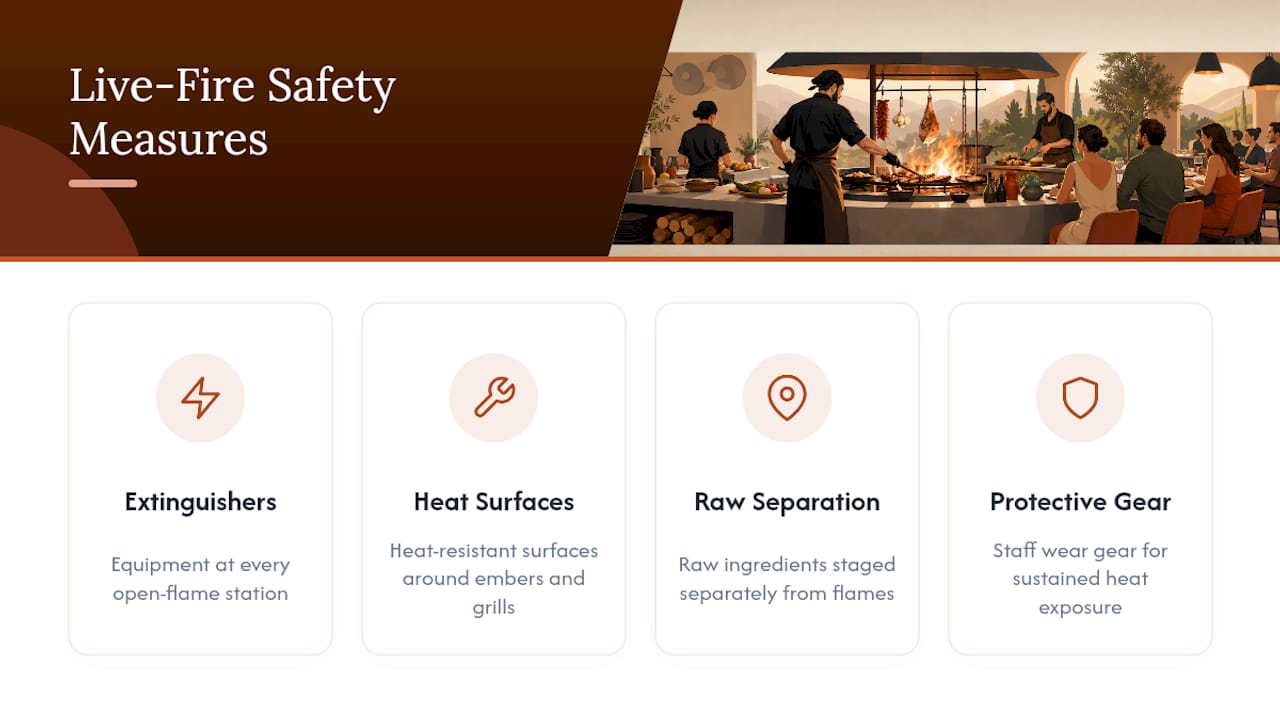
Fire-specific protocols typically include dedicated extinguishing equipment near every open flame station, heat-resistant surfaces around embers and grills, and strict separation between raw ingredients staged near a fire and the flame itself to avoid contamination. Staff working the fire line wear protective gear suited to sustained heat exposure, not just quick grilling bursts, since a service can run for hours at high temperatures.
For diners, the visible signs of a well-run live-fire kitchen are practical: clear sightlines that keep guests a safe distance from active flame, staff who move with obvious familiarity around embers and coals, and a dining room that doesn’t feel smoky or oppressively hot despite sitting near the fire. If a restaurant seats you directly at a chef’s counter, ask how the kitchen manages heat and smoke for guest comfort. A confident, specific answer is a good sign the operation takes it seriously.
Traditional and Modern Live Fire Cooking Techniques Around the World
Cooking over open flame predates every modern kitchen tool by thousands of years, and a lot of what shows up on a tasting menu today borrows directly from techniques with deep regional roots. Argentine asado traditions built entire cooking systems around distance and time, adjusting how far meat sits from the coals rather than adjusting the fire itself. Basque grilling culture, most famously associated with the Etxebarri region, treats wood selection as inseparable from the ingredient, matching specific woods to specific proteins and vegetables for aroma as much as heat.
Japanese robata grilling uses binchotan charcoal, prized for burning at a very high, steady temperature with minimal smoke, letting a chef sear quickly without masking a delicate ingredient’s own flavor. Nordic and Scandinavian kitchens have leaned into ash and ember contact, cooking vegetables directly in coals for a texture no oven replicates.
What’s changed in contemporary fine dining is precision. Chefs now custom-build grills with pulley systems, adjustable grates, and multiple heat zones on a single fire, letting one station handle a delicate fish and a hard-charred vegetable at the same time. The technique is ancient. The control is new, and that control is exactly what separates a tasting menu that uses fire as a genuine culinary tool from one that uses it as a gimmick.
Equipment and Tools Essential for Live Fire Cooking
The equipment behind a live-fire tasting menu goes well beyond a basic grill. Custom-built asadores, often adjustable by pulley or crank, let a chef raise or lower a grate over coals to fine-tune heat exposure without moving the fire itself. This kind of rig, central to kitchens like Asador Etxebarri, allows one fire to cook a dozen different ingredients at a dozen different intensities across a single service.
Beyond the main grill, the tools that matter most include:
- Skewers and spits for even, rotating exposure on items that need consistent heat from every side.
- Handheld torches for precise, targeted caramelization on a finished plate right before service.
- Plancha and cast-iron surfaces set directly over embers for high, even searing without direct flame contact.
- Wood-fired ovens for slower, enclosed heat that behaves differently than open-flame grilling.
- Ash pits or ember beds built specifically for direct-contact cooking of root vegetables and other sturdy ingredients.
None of this works without a reliable fuel source and a chef who understands how each tool changes the outcome, which is why the best fire-driven kitchens treat their equipment as inseparable from the technique itself.
How Fire Changes Flavor and Texture at a Chemical Level
The flavor payoff of live fire cooking comes down to a handful of real chemical reactions, not just aesthetics. The Maillard reaction, triggered by high, direct heat, browns proteins and sugars on a food’s surface, creating hundreds of new aromatic compounds that don’t exist in the raw ingredient. This is why a seared piece of fish smells and tastes fundamentally different from a poached one, even with identical seasoning.
Smoke adds a separate layer entirely. Compounds released from smoldering wood, phenols and other aromatic molecules, settle onto food’s surface and penetrate slightly below it, which is why controlled smoking over a distance produces a lighter, more integrated flavor than direct exposure to thick smoke. Caramelization, meanwhile, targets sugars specifically, which is why a torch works so precisely on a dessert element or a glazed vegetable: it’s chasing sugar content, not protein.
Texture shifts alongside flavor. Fast, high-heat searing seals a crust quickly while keeping the interior tender, and ember contact often dries and concentrates a food’s exterior while leaving the center closer to steamed. A chef choosing between a plancha, an open flame, or direct ash contact isn’t picking a look. They’re picking a specific chemical outcome, and that decision is exactly what separates a technically thoughtful tasting menu from one that’s simply cooking over fire because it looks dramatic.
Environmental and Sustainability Considerations for Fuel Sourcing
Fire-centric kitchens burn through a lot of wood and charcoal over a single service, which raises real questions about where that fuel comes from and how sustainably it’s harvested. Hardwoods like oak, grapevine cuttings, and fruit woods are commonly favored for their slow burn and distinct aromatic profiles, but sourcing them responsibly means working with suppliers who manage forests or orchards rather than clear-cutting for short-term supply.
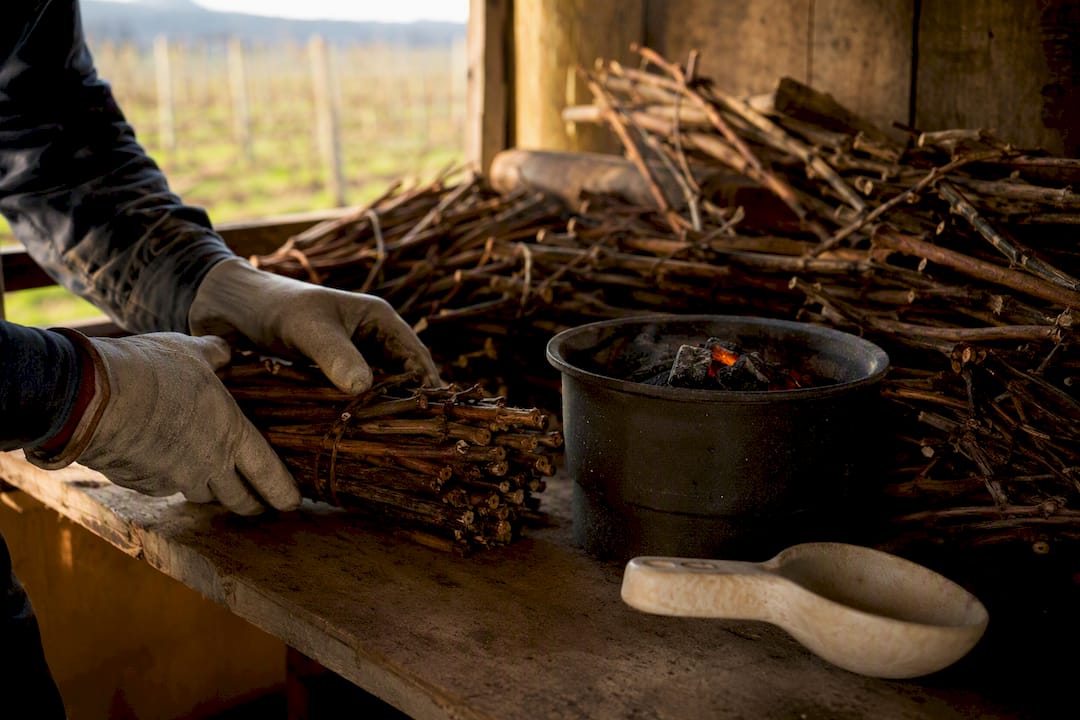
Charcoal production carries its own environmental weight, since poorly managed charcoal comes from unsustainable logging in some regions. Restaurants serious about their fuel sourcing increasingly favor charcoal certified from managed woodlands or byproduct wood from agricultural pruning, like grapevine cuttings that would otherwise go to waste. Using orchard and vineyard trimmings as cooking fuel is one of the more elegant solutions in the space: it repurposes agricultural waste instead of demanding new timber, and it often lends more distinctive flavor than commodity charcoal.
The broader trend toward sensory, fire-driven dining shows no sign of slowing, with sustainability increasingly part of the conversation for kitchens looking ahead (2026 trend coverage on fire and sensory dining). A kitchen that can name its wood supplier and explain its sourcing logic is usually a kitchen that’s thought this through rather than treating fire as disposable theater.
How Aflamas Approaches Live-Fire Tasting Menus
Aflamas builds its tasting menus around fire as a working technique, pairing modern methods with local ingredients rather than treating flame as a gimmick. The kitchen accommodates vegetarian, vegan, gluten-free, and lactose-free guests when notified in advance.
— YellowRock
Book the Aflamas Tasting Menu
Aflamas gives you what a lot of fire-driven tasting menus only promise: technique-first cooking where smoke, embers, and char are chosen deliberately for each course, not layered on for spectacle.
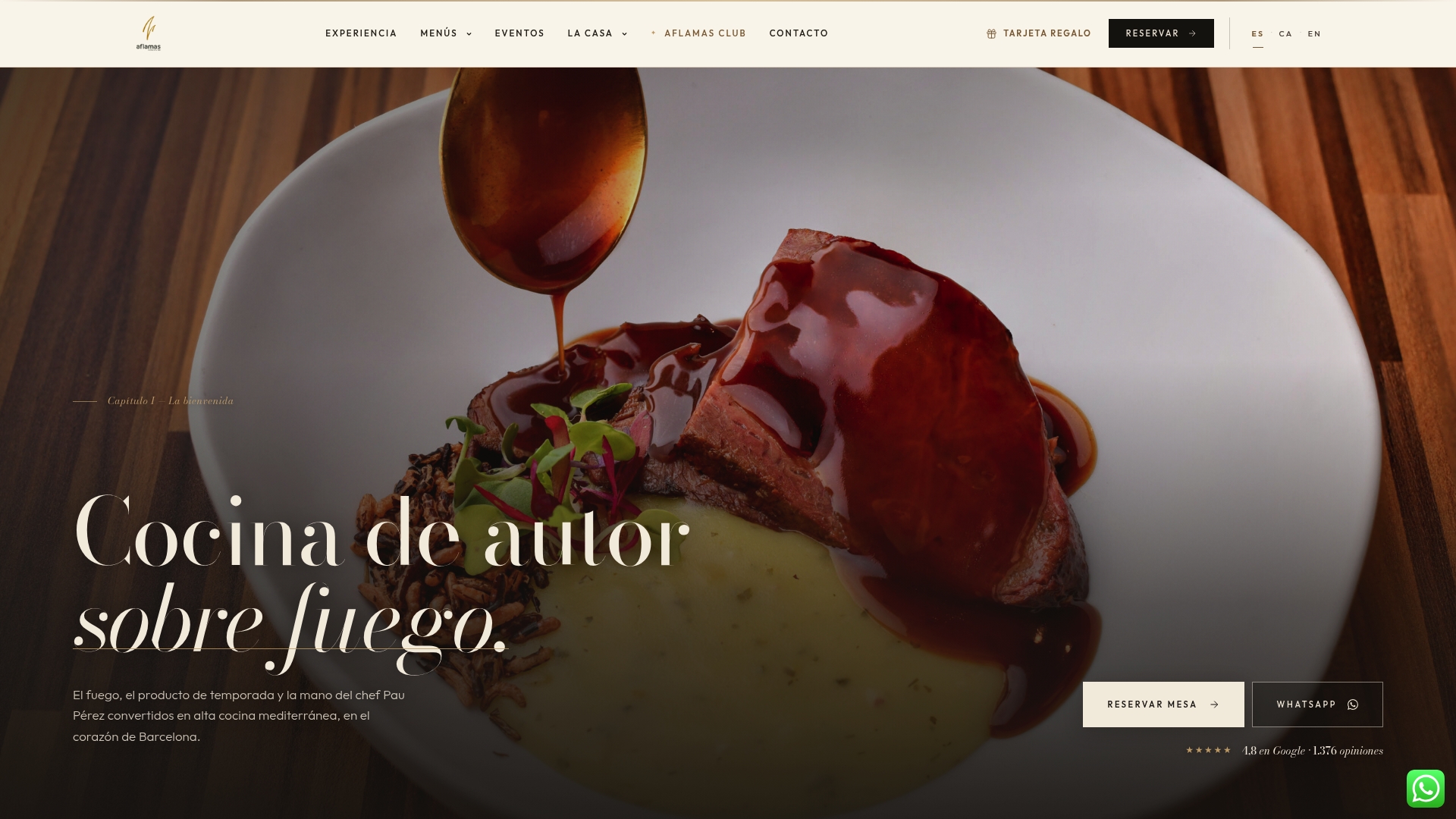
The current tasting menu walks through multiple courses built around live fire, with menu consultation available for vegetarian, vegan, gluten-free, and lactose-free guests before you even sit down. If you’d rather explore the kitchen’s signature approach to flame-forward dishes first, the signature menu shows specific plates built around direct fire, smoke, and grilled ingredients. Planning a celebration or a group event, Aflamas also handles private dining and personalized group menus, and gift cards are available if you want to send this experience to someone else instead of booking it yourself. Reserve your seat through the tasting menu page, note any dietary needs at booking, and the kitchen will take it from there.
Sources
- El Enigma es Albert Adrià: camino de la década, el restaurante rompe las reglas del menú
- Inside Asador Etxebarri, if you know, you know
- Inside San Francisco’s New Live Fire Tasting Menu Restaurant Osito
FAQ
What Does “Live Fire Cooking” Mean on a Tasting Menu?
It refers to chef-driven techniques, direct searing, ember cooking, controlled smoking, and torching, used as core methods across a multi-course tasting menu rather than one showcase dish.
How Long Does a Live Fire Tasting-Menu Dinner Take?
Most run between 90 and 180 minutes depending on course count and how much the kitchen explains each dish during service.
Can Live Fire Tasting Menus Accommodate Dietary Restrictions?
Yes. Fine-dining kitchens generally adjust fire-cooked courses for vegetarian, vegan, gluten-free, and lactose-free guests when notified during booking, and Aflamas offers menu consultation for exactly this purpose.
Will I Be Uncomfortably Hot Near the Fire?
Seating close to an open flame runs warmer than a standard table, so lighter layers help, and you can request seating farther from the heat when you reserve.
How Much Does a Live Fire Tasting Menu Typically Cost?
Pricing follows standard fine-dining tasting-menu ranges and varies by restaurant and course count; current pricing for Aflamas is listed on its tasting menu page.