
Multisensory dining is a meal designed so that sight, sound, scent, touch, and taste work together on purpose, rather than food simply being served under whatever light and noise happen to be in the room. Restaurants like Aflamas build tasting menus around this idea, and sensory science research backs it up: combined sensory input sharpens how accurately and quickly people judge flavor. The payoff is a meal you actually remember.
TL;DR:
- Combining sensory inputs in multisensory dining enhances flavor perception by improving judgment speed and accuracy, supported by sensory science research.
- Using just two levers, such as lighting and sound or scent and plating, before adding more, helps prevent sensory overload and creates a more immersive experience.
- Designing or evaluating multisensory meals involves choosing a narrative, selecting a few sensory levers, testing the sequence, and adjusting for individual sensitivities.
- Low-tech formats like dark dining and narrative tasting menus remain effective and accessible, while high-tech options continue to evolve with augmented reality and projection.
- To achieve a balanced experience, diners should expect options that accommodate sensory sensitivities, such as quieter sections, reduced scents, and clear communication from venues.
Table of Contents
- What multisensory dining is and what the science says
- How multisensory design works in practice
- How to design or evaluate a multisensory meal
- Formats and examples worth trying
- Making multisensory dining sensory-friendly for everyone
- Aflamas as a working example of chef-driven multisensory dining
- How multisensory dining evolved and why it matters culturally
- What the research actually shows about taste and enjoyment
- Why sensory integration affects your brain and body at dinner
- Restaurants and projects known for immersive sensory dining
- Where multisensory dining is headed next
- What can go wrong: overload, cost, and mismatched expectations
- What a well-built sensory meal actually feels like
- How to book a multisensory meal at Aflamas
- Sources
- FAQ
What multisensory dining is and what the science says
Multisensory dining rests on cross-modal integration: the brain does not process taste in isolation. Sight, sound, smell, and touch all feed into the same judgment your mind makes about what is in your mouth, and each one can shift that judgment. A crunch sound can make a chip taste fresher. A red light can make a dessert taste sweeter than it is. A heavy plate can make the food on it seem more substantial.
The Springer chapter on multisensory perception explains why restaurants lean into this: sensory inputs are combined in the central nervous system, and that combination improves both the speed and the accuracy of sensory judgments compared to relying on a single channel, such as taste alone. In practice, that means a chef who coordinates aroma, sound, and visual cues alongside the dish itself is not adding decoration. They are giving your brain more consistent information to work with.
Combined sensory inputs improve the speed and accuracy of flavor judgments compared to single-channel tasting, according to research on multisensory perception. That is the empirical basis for treating light, sound, and scent as ingredients rather than atmosphere.
How multisensory design works in practice
Once you accept that the senses interact, the design question becomes which levers to pull and how far. Each one has a fairly predictable effect when used with intent.
- Lighting: warm, dim light tends to slow eating pace and make flavors read as richer; harsh overhead light does the opposite.
- Sound: a soundtrack matched to a dish’s origin or mood can raise perceived quality, while mismatched or overly loud sound can flatten flavor perception entirely.
- Scent: a lead aroma released just before a course arrives can prime the palate, but competing smells from other tables or dishes cancel each other out.
- Texture: plate weight, cutlery shape, and tableware material change how substantial or delicate a dish feels in the hand before it even reaches the mouth.
- Plating: color contrast and height draw attention to specific ingredients and can make a dish seem more or less generous.
- Pacing: the gap between courses shapes anticipation, and rushing a reveal undercuts the sensory buildup a dish was built around.
The common mistake is trying to activate all five senses in one sitting, which tends to overwhelm rather than enhance. Industry guidance on building sensory experiences recommends starting with one coordinated visual and olfactory cue rather than attempting every channel at once.
Pro Tip: Pick two levers, usually lighting and sound or scent and plating, and get those right before adding a third.
How to design or evaluate a multisensory meal
Whether you are hosting a dinner at home or booking a professional experience, the planning steps are similar: pick a story, choose a small number of sensory levers, and test before committing.
- Choose a narrative: decide what story the meal tells, whether it is a region, a season, or a memory, since every sensory choice should support it.
- Select two or three levers: lighting and sound are the easiest starting pair; add scent once the first two feel natural.
- Prototype the sequence: run through the course order and sensory cues once before the real event to catch mismatched timing.
- Test on a small group: a trial run with two or three people reveals what feels immersive versus what feels distracting.
- Adapt for dietary needs: confirm vegetarian, vegan, gluten-free, or lactose-free options before finalizing the menu.
If you are booking rather than hosting, ask the venue directly about intensity, expected duration, what is included in the price, dietary accommodation, and whether accessibility options exist. Realistic sessions vary in length depending on the number of courses, and pricing varies widely by venue and format, so it is worth confirming both before you book.
Formats and examples worth trying
Immersive dining takes several recognizable shapes, and each one leans on a different sense.
- Installation-driven dinners: physical sets, sculptures, or themed rooms that prioritize sight and spatial immersion.
- Table-projection dinners: animated visuals mapped directly onto the tablecloth or plate, again sight-led but tied tightly to course timing.
- Dark dining: guests eat without visual input at all, which sharpens attention on smell, texture, and sound.
- Narrative tasting menus: each course advances a story, usually through a chef’s introduction, pacing, and plating rather than technology.
- Pop-up sensory rooms: temporary spaces built around a single theme, often combining scent and sound design for a short run.
Design projects such as The Liminal Eatery at HfG Karlsruhe combine augmented reality, projection, scent, and tactile objects to show how far these tactics can go. At home, three low-effort adaptations replicate the core idea: dim the lights and play a matched playlist to mimic a narrative tasting menu, light a scented candle tied to the meal’s theme to mimic olfactory priming, and swap in heavier or lighter tableware to test how touch changes perceived portion size.
Making multisensory dining sensory-friendly for everyone
Not every guest experiences intense sound, bright light, or strong scent the same way, and a well-designed experience accounts for that rather than assuming one intensity fits all.
- Common triggers: loud or sudden sound, flashing or strobing light, and strong or layered scents are the most frequent sources of discomfort.
- Practical adaptations: offer a quiet or low-scent seating section, brief guests on what to expect before the meal starts, and provide tactile or verbal alternatives when visual cues are central to a course.
Research from the University of Graz on multisensory processing found that traits such as openness to experience and food-related disgust sensitivity significantly change how people process combined sensory input, which is the underlying reason adaptability matters more than a single “correct” intensity level.
Pro Tip: Ask any host or venue what happens if a course is too intense for you, and choose ones with a clear answer.
Aflamas as a working example of chef-driven multisensory dining
A tasting menu is one of the more accessible ways to experience coordinated sensory design without technology or theatrical staging. At this contemporary fine dining restaurant built around fire-based cooking techniques, pacing, plating, and course sequencing are used to build a sensory arc across the meal rather than treating each dish as a standalone plate.
The restaurant’s tasting formats, including the Menú Ejecutivo and seasonal and author-driven menus, apply this thinking through ingredient choice, plating, and timing between courses. Private dining rooms extend the same approach to group celebrations and events, and the menus typically include adaptations for vegetarian, vegan, gluten-free, and lactose-free diets. Readers curious about the chef’s approach to fire and local ingredients can find more detail on the chef’s background page.
How multisensory dining evolved and why it matters culturally
Eating with more than taste in mind is not a recent invention. Formal dining rooms, table settings, music at banquets, and ritual food presentation go back centuries across cultures, all built on the same intuition chefs formalize today: how a meal looks, sounds, and feels changes how it is remembered.
What has changed is the deliberateness. Where music at a medieval feast or careful plating at a formal dinner served social and aesthetic purposes, modern multisensory dining treats those same elements as tools for shaping flavor perception itself, informed by an understanding of how the brain actually processes combined sensory input. The rise of tasting menus as a format, rather than à la carte ordering, reflects this shift: a tasting menu lets a chef control pacing and sequence in a way a single dish never can.
Industry observers describe this shift as a move toward “wonder” as a central goal of hospitality. A presentation on culinary experiences frames coordinated sensory narratives as a way to produce a restorative, memorable experience, arguing that this kind of wonder has become a defining currency in gastronomy and tourism. That framing explains why immersive formats keep appearing in cities with strong food tourism: they are not just entertainment, they are a way to make a single meal stand out in memory long after the plate is cleared. A traveler’s guide to culinary experiences makes a similar point about sensory design shaping guest satisfaction on food-focused trips.
What the research actually shows about taste and enjoyment
The core scientific claim behind multisensory dining is that taste is not a fixed signal the tongue sends to the brain. It is a judgment the brain builds from multiple inputs at once, and changing those inputs changes the judgment.
The Springer chapter on multisensory perception lays out the mechanism: combined sensory inputs are processed together in the central nervous system, and that combination produces faster, more accurate sensory judgments than any single channel working alone. That is a meaningful distinction from saying multisensory design simply makes food “seem” better. It suggests the brain is doing more reliable work when it has more consistent signals to draw on, not just more distraction.
Timing matters as much as which senses are involved. Cross-modal perception research from the University of Graz found that the order of sensory cues changes the outcome: presenting a visual cue before an olfactory cue produced stronger taste perception than the reverse order. That is a practical detail as much as a scientific one. A chef who shows a dish before releasing its aroma is giving the brain a reference point to interpret smell against, rather than presenting scent and sight as competing, unordered signals.

None of this means multisensory design can manufacture flavor that is not there. It means the perception of the flavor that is there, its intensity, its freshness, its complexity, is measurably shaped by what else is happening at the table.
Why sensory integration affects your brain and body at dinner
The mechanism behind multisensory dining is not purely psychological. It shows up in measurable brain and body responses, not just self-reported enjoyment.
Neuroimaging and event-related potential studies referenced in University of Graz research report changes in neural response amplitude and shifts in appetite ratings when sensory cues are manipulated together rather than presented alone. That points to sensory integration happening at a level below conscious choice: the brain is registering combined light, sound, and scent cues and adjusting appetite and reward signals before a diner has consciously evaluated a dish.
This is also where individual variation becomes important rather than a footnote. The same research found that personality traits, specifically openness to experience and food-related disgust sensitivity, significantly change how multisensory stimuli are processed neurally. Two guests at the same immersive dinner can have genuinely different physiological responses to the same lighting, sound, and scent combination, not just different opinions about it.
Practically, that explains two things restaurant designers already know from experience. First, why a stabilizing element, usually a neutral palate cleanser like still water or a plain cracker between courses, helps reset the palate after a strong trigeminal stimulus such as chili or strong acidity. Second, why the same immersive format lands as delightful for one guest and overwhelming for another seated at the next table. Sensory integration is a real physiological process, but it is not a uniform one.
Restaurants and projects known for immersive sensory dining
A handful of formats have become reference points for what immersive dining can look like at different budget levels. Projection-mapped dinners, where animated visuals are tracked onto a table or plate in real time, represent a high-tech end of the spectrum, alongside larger themed attractions that combine multiple sensory rooms into a single visit.

Dark dining sits at the opposite end: no special equipment beyond controlled lighting, but a strong perceptual effect from removing sight entirely and letting smell, texture, and sound carry the meal. Coverage of experience-driven gastronomy documents this range, noting that immersive concepts scale from low-tech formats like dark dining to high-tech tracked projection systems depending on a venue’s budget and goals.
Design-research projects occupy a third category, closer to experimental prototypes than commercial restaurants. The Liminal Eatery project at HfG Karlsruhe combines augmented reality, projection, scent modules, and tactile tableware to explore what a “phygital” (physical plus digital) meal can do that a purely physical one cannot. These projects tend to test ideas that commercial venues adopt later in simplified form, once the technology becomes cheaper and more reliable.
Chef-driven tasting menus represent a fourth, lower-tech category that relies on sequencing, plating, and narrative rather than projection or augmented reality, achieving a similar sensory arc through pacing and ingredient choice alone.
Where multisensory dining is headed next
The clearest trend is toward “phygital” formats, blending physical tableware and food with digital layers like augmented reality overlays or projection, rather than choosing one or the other. The Liminal Eatery is an early example of this direction, using AR and projection alongside physical scent and tactile objects rather than replacing them.
A second trend is toward tighter sequencing based on how the brain actually processes combined cues, rather than adding sensory elements decoratively. As research on cue ordering becomes more available to chefs and designers, expect more menus built around a specific sequence, such as a stabilizing visual reference before an aroma is released, instead of simultaneous sensory “reveals” for effect.
A third trend, driven by accessibility demands rather than technology, is toward built-in adaptability. Given that individual differences in traits like disgust sensitivity and openness to experience meaningfully change how guests process the same stimuli, venues that offer adjustable intensity, low-scent seating, or advance sensory briefings are likely to become the norm rather than an accommodation offered only on request.
Finally, expect continued growth in low-tech formats alongside high-tech ones. Dark dining and narrative tasting menus require no special equipment and remain some of the most reliable ways to produce a strong sensory effect, which keeps them relevant even as projection and AR-based dining become more accessible.
What can go wrong: overload, cost, and mismatched expectations
The most common failure mode in multisensory dining is sensory overload: too many cues competing for attention at once, which tends to flatten enjoyment rather than heighten it. This is consistent with the underlying science. If combined sensory input works because it gives the brain consistent, reinforcing signals, then contradictory or excessive signals do the opposite, forcing the brain to work harder to resolve conflicting information instead of arriving at a clearer, faster judgment.
Individual variation compounds the risk. Because traits like food-related disgust sensitivity and openness to experience significantly change how people process the same stimuli, a format that delights one table can genuinely distress another seated a few feet away. Venues that do not offer a lower-intensity option or advance notice of strong scents, loud sound, or flashing light put guests with sensory sensitivities in a difficult position.
Cost and access are practical limitations too. High-tech formats like tracked projection mapping or large-scale immersive attractions require real capital investment, which limits how widely available they are compared to a dark dining night or a narrative tasting menu that needs only lighting control and a well-sequenced menu. Trade coverage of experience-driven gastronomy notes this range directly: immersive concepts scale from low-tech to high-tech depending on what a venue can afford to build and maintain.
Finally, there is a simpler risk: novelty fades. A format built purely on spectacle, without a genuine sensory or narrative logic behind it, tends to feel gimmicky on a second visit. The formats that hold up over repeat visits tend to be the ones where the sensory design serves the food, rather than the other way around.
What a well-built sensory meal actually feels like
The lights had dropped to a low amber by the second course, and a faint charred-citrus scent arrived just before the plate did. The sound underneath it was quiet, almost a heartbeat, and the plate itself was heavier than expected in the hand. None of it was loud, but by the third course the table had gone quiet in a different way, paying attention rather than performing conversation. That shift, from eating to noticing, is what the levers above are built to produce.
— YellowRock
How to book a multisensory meal at Aflamas
If you want to experience this kind of coordinated design rather than build it yourself, a chef-led tasting menu is the most direct route, and it requires no equipment or planning on your part beyond choosing a date. Aflamas offers several tasting formats built around fire-based cooking and seasonal, local ingredients, with full adaptation for vegetarian, vegan, gluten-free, and lactose-free diets.
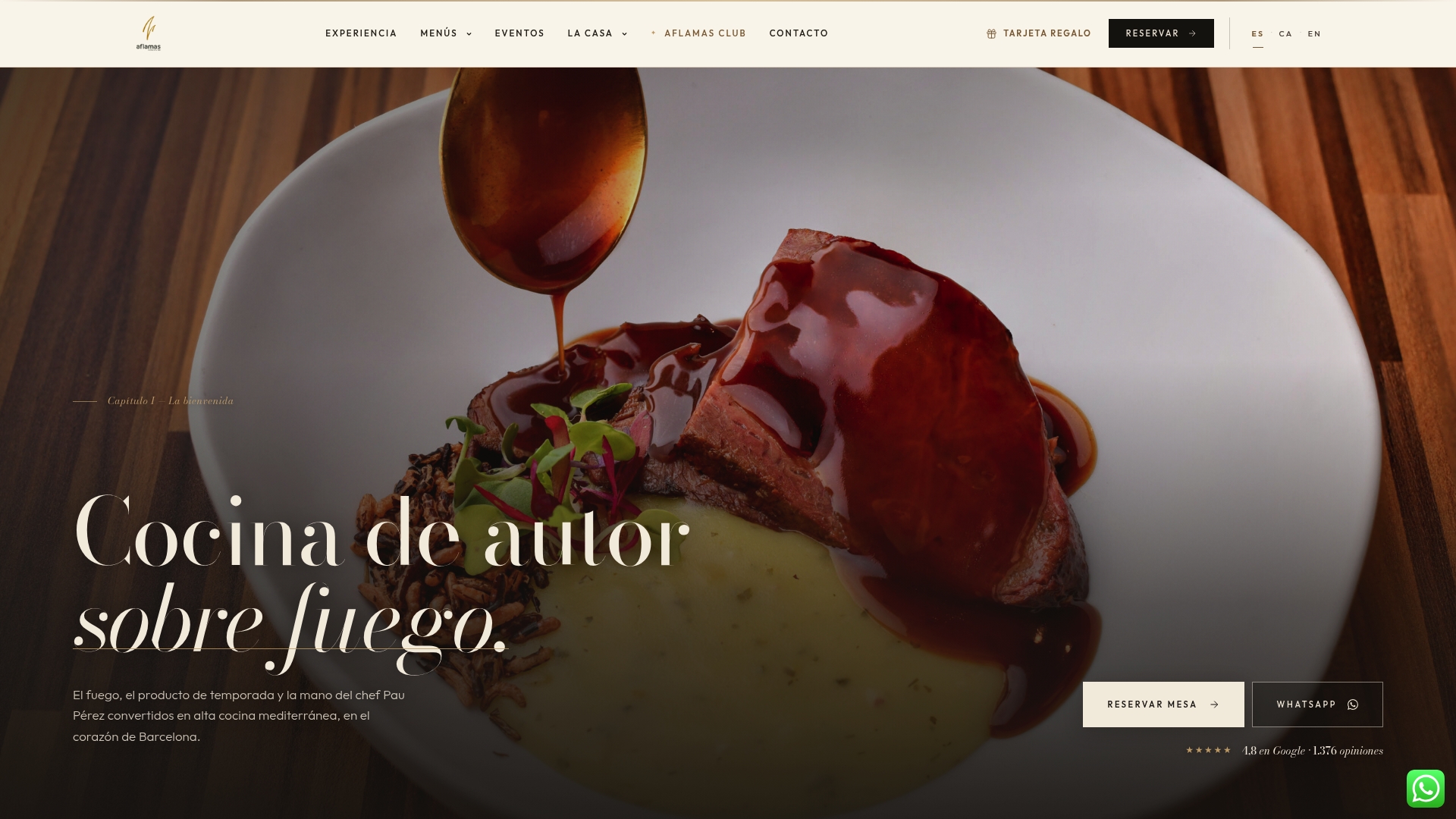
- The Menú Temporada and Menú Selección Autor offer two different tasting sequences built around seasonal and chef-driven sensory pacing.
- Menú Grupos and the Alma, Fuego, and Pasión formats at Aflamas extend the same approach to group celebrations and private events.
- A Tarjeta regalo lets you give someone else the experience without deciding the menu for them.
Sources
- Springer chapter on multisensory perception (sensory science)
- University of Graz multisensory fMRI research
- The Liminal Eatery project (HfG Karlsruhe)
- Mehr als Genuss: Culinary experiences and their multisensory role (BZT presentation)
FAQ
What is multi-sensory dining?
Multisensory dining is a meal designed so that sight, sound, scent, touch, and taste work together intentionally rather than by accident. Sensory science research shows that combining these inputs improves the speed and accuracy of flavor judgments compared to taste alone.
Can you give me an example of immersive dining?
Formats range from low-tech dark dining, where guests eat without visual input, to high-tech table-projection dinners with animated visuals tracked onto the plate. A chef-driven tasting menu that sequences pacing, plating, and aroma across courses, such as the formats served at Aflamas, is a lower-tech but still deliberate example.
What are some ideas for sensory-friendly meals?
Offer a quiet or low-scent seating section, brief guests in advance about what sensory cues to expect, and provide a lower-intensity version of any strong scent, sound, or lighting element. This matters because University of Graz research found that traits like disgust sensitivity and openness to experience significantly change how people process the same sensory stimuli.
What does immersive dining mean?
Immersive dining means the meal itself becomes a coordinated experience built around a narrative, using lighting, sound, scent, and plating alongside the food rather than treating those elements as background. The goal, as industry framing puts it, is to produce a sense of wonder that strengthens memory of the meal.