Spain eats later than most of Europe. Lunch, the main meal, is usually between 2 p.m. and 3 p.m., and dinner starts around 9 p.m. In Barcelona, kitchens often open for dinner a little earlier, and that window is shifting. Here is the full daily rhythm, what changes by city and weekday, and how to plan your meals so you are never standing at a closed kitchen door.
TL;DR
- Typical home schedule: breakfast 7 to 9 a.m., lunch 2 to 3 p.m., dinner 9 to 10:30 p.m.
- Barcelona dinner is commonly served from 9 p.m., and many restaurants open their kitchens around 8 p.m. to 8:30 p.m.
- Dinner is moving earlier: 2026 reservation data shows 8 p.m. bookings rising fast and 10 p.m. bookings falling.
- Between lunch and dinner, many independent restaurants close, so check kitchen hours and book ahead on weekends.
- The 4 p.m. to 6 p.m. snack is called merienda.
Table of Contents
- The standard Spanish day, hour by hour
- Lunch: the meal that sets the day
- Dinner: is it really 10 p.m.?
- Dinner time in Barcelona
- How it varies by region and season
- Tapas, bars and the “light dinner” question
- Booking tips that save you from a closed kitchen
- Perspective: why we build a service around the Spanish evening
- Plan your Barcelona dinner with Aflamas
- Eating with dietary needs on a Spanish schedule
- A sample day in Barcelona
- FAQ
- Sources
The standard Spanish day, hour by hour
The most useful reference is a Spanish Ministry of Education learning text for foreign students. It describes the customary home schedule as breakfast between 7 and 9 a.m., lunch between 2 and 3 p.m., and dinner between 9 and 10:30 p.m. Media reports give the same picture: The Local puts dinner between 9 p.m. and 10 p.m., with lunch around 2 to 3 p.m.
Official tourism guidance is a little wider, because it describes what restaurants do rather than what families do. Spain’s national tourism portal says restaurants usually serve lunch from 13:00 to 16:00 and dinner from 20:00 to 23:30, with dinner running to 23:30 in big cities and in summer.
Here is how it reads on a normal weekday:
| Meal | Spanish name | Typical time | What to expect |
|---|---|---|---|
| Breakfast | desayuno | 7:00 to 9:00 | Coffee and toast or a pastry, often eaten standing at a bar |
| Mid-morning bite | almuerzo or tentempié | 11:00 to 11:30 | A small sandwich and a second coffee |
| Lunch | comida | 2:00 to 3:00 p.m. | The main meal of the day, often several courses |
| Afternoon snack | merienda | 5:00 to 6:00 p.m. | Something sweet or a small sandwich |
| Dinner | cena | 9:00 to 10:30 p.m. | Usually lighter than lunch on weekdays |
The mid-morning and afternoon snacks are described in Spanish food-culture guides such as eHispanismo, which notes that the Spanish day has five meals and few people skip any of them.
What is a meal at 4 p.m. called?
It is called merienda. It is the light afternoon snack, traditionally for children after school but enjoyed by plenty of adults too. A food guide on Spanish meals places it between 5 p.m. and 6 p.m., so a 4 p.m. bite is a late lunch or an early merienda depending on who you ask.
Lunch: the meal that sets the day
Lunch is the main meal, not dinner. Cultural Atlas describes it as generally eaten between 2 p.m. and 4 p.m., and Snopes reports that it commonly starts around 2:30 p.m.
If you arrive at a restaurant at noon expecting lunch, expect an empty room and, often, a kitchen that is not yet cooking the full menu. Many places serve a fixed-price lunch menu on weekdays, which is the best-value way to eat the main meal like a local.
After the meal comes the lingering. Barcelona’s city hall explains that late meals go together with Spain’s later working-day pattern and that sobremesa, the time spent chatting at the table after eating, is part of local custom. We wrote a separate piece on the meaning of sobremesa if you want to see why rushing it misses the point.
Dinner: is it really 10 p.m.?
Sometimes, but not always, and less than it used to be. The myth of dinner at midnight is just that: Snopes found that dinner typically begins around 9 p.m., more often 10 p.m., rather than at midnight. Cultural Atlas gives a range of 9 p.m. to 11:30 p.m., with dinner starting around 10 p.m. or later on weekends.
The habit is also moving. The New York Times reported in 2026 that half of dinner bookings on the CoverManager platform now fall before 9 p.m. The same article cites TheFork data showing that 10 p.m. reservations have halved since 2019 while 8 p.m. bookings have nearly tripled.
What this means for you as a visitor: an 8:30 p.m. table is no longer a tourist-only choice. It is a normal booking, and it often means a calmer room and a more relaxed pace.

Why so late?
The explanations people give are the working day, with its long midday break, and the time zone. One Spanish food writer argues that mealtimes follow the sun, so lunch shifted from 1 to 2 p.m. and dinner from 8 to 9 p.m. after the time-zone change. Whatever the cause, the schedule is a social habit more than a rule.
Dinner time in Barcelona
Barcelona follows the national pattern with a few city-specific details. The city’s official welcome page says lunch is normally between 2 p.m. and 3 p.m. and dinner commonly from 9 p.m. onward, often around 10 p.m.
In practice:
- Early dinner (8:00 to 8:30 p.m.): Many restaurants open their dinner service around now, and you will find the dining room mostly visitors and early-evening locals.
- Standard dinner (9:00 to 9:30 p.m.): The sweet spot. The room fills and the kitchen is at full pace.
- Late dinner (10:00 p.m. onward): Common on weekends and in summer, but check the last kitchen order before you go.
- The afternoon gap: Many independent restaurants close between lunch and dinner service, so a 5 p.m. table is hard to find outside bars and cafés.
The opening hours of any individual restaurant are the only ones that count, so confirm them on the venue’s own page before you build a day around them.
How it varies by region and season
Spain is not one schedule. The Andalusian tourism board lists a broader pattern: breakfast 08:00 to 10:30, restaurant lunch 13:00 to 15:30 and dinner 20:30 to 23:00. Lonely Planet notes that in Andalusia bars and restaurants often stay open until 1 a.m. because of the heat, while in the Basque Country they tend to close around 11 p.m.
Three rules of thumb:
- South and summer run later. Heat pushes dinner into the night.
- The north and winter run earlier. You can eat at 8:30 p.m. without raising an eyebrow.
- Weekends run later. Dinner at 10 p.m. or after is far more common on Friday and Saturday.
Tapas, bars and the “light dinner” question
A common worry from visitors is whether dinner is a big meal. On weekdays it is often lighter than lunch: tapas, shared plates, a salad or a tortilla. Bars serve food through much of the day, so if you are hungry at 6 p.m. you will find something at a counter, even if a sit-down restaurant is closed.

A tasting-menu dinner is the other end of the spectrum. It is an evening in itself, usually two to three hours, and it fits the Spanish idea of dinner as a social event rather than a refuel.
Booking tips that save you from a closed kitchen
Advance booking is the single most useful habit. Reserving ahead is standard for popular or small restaurants, especially on weekends, while many traditional tapas bars do not take reservations at all. If you are new to online systems, this guide to digital reservations for travelers explains what confirmation emails and deposits usually look like.
A short checklist:
- Check the last kitchen order, not just closing time. The kitchen often stops before the bar does.
- Book dinner for 8:30 or 9:00 p.m. if you want a full room without a very late finish.
- Book lunch for 2:00 p.m. or later if you want the local rhythm. Before 1:30 p.m. you may be early.
- Read the cancellation terms on any fine-dining booking. Our piece on a €510 cancellation fee that held up in Spain shows why.
- Know the tipping norm. Our guide to tipping in Spain explains when €1 to €3 is enough.
If you are dining alone, you will find our advice on solo dining useful, since single tables at 9 p.m. are easier than they sound.
Perspective: why we build a service around the Spanish evening
We cook with fire and with local, seasonal products, and that kind of cooking asks for time. A tasting menu is not a quick dinner. It is paced to the way Spain already eats: unhurried, shared, and with a long stop at the table.
That is why we see the shift toward earlier dinners as good news for our guests. A table at 8:30 p.m. leaves room for every course, a conversation between them, and a walk home through Barcelona without watching the clock.
Our menus are designed so that diners who are vegetarian, vegan, gluten-free or lactose-free sit down to the same experience as everyone else, not a reduced version of it. When you plan your evening, choose the time that lets you enjoy the sobremesa, and tell us your needs when you book.
YellowRock
Plan your Barcelona dinner with Aflamas
If you are choosing a table for your first Spanish evening, we offer contemporary, fire-led tasting menus in Barcelona. The Menú Ejecutivo is €35 per person, the Menú Temporada is €60, the Menú Selección Autor is €90 and the Menú Festival is €150, all per person.
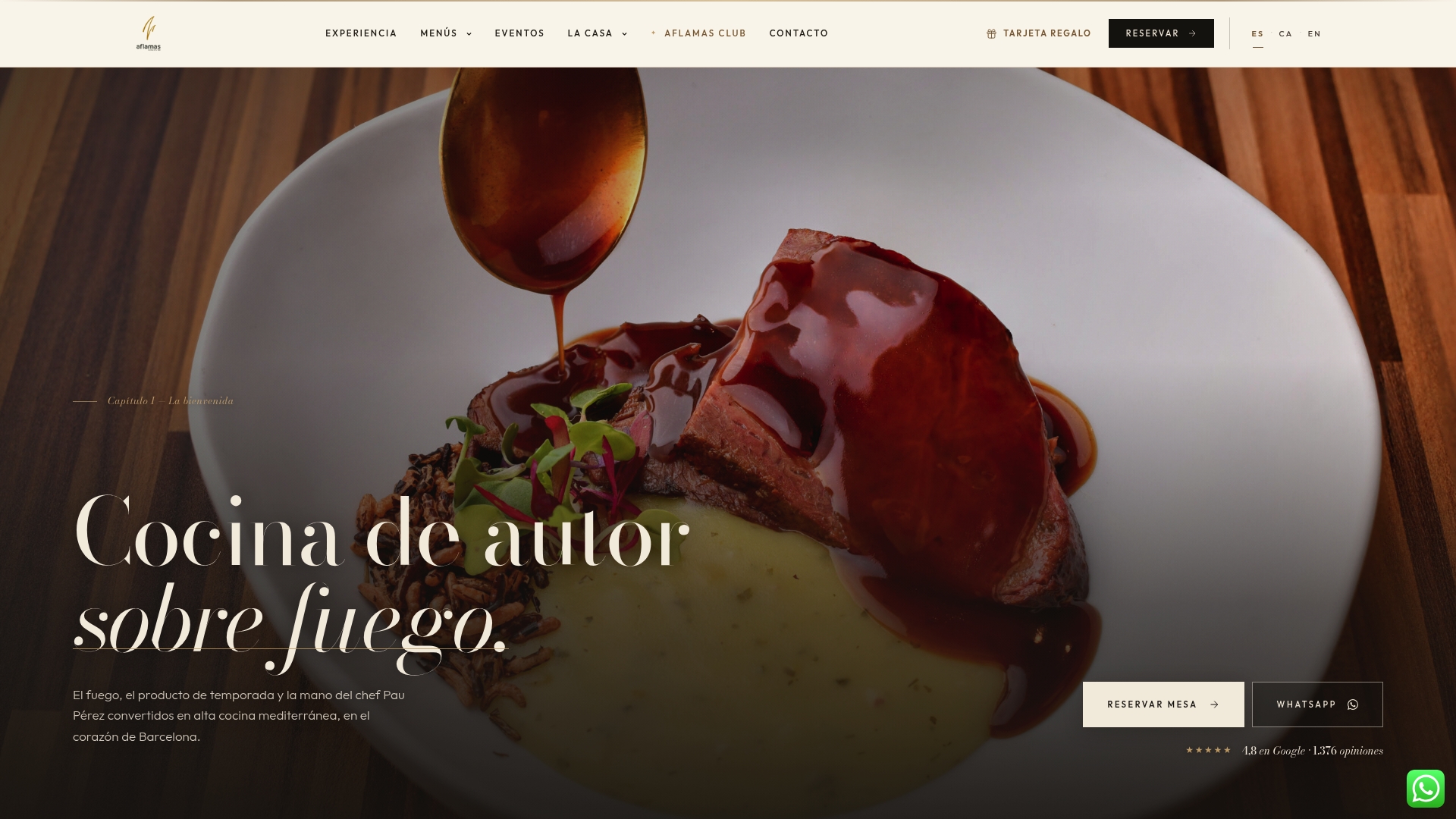
For celebrations, our private dining rooms and group menus (Alma from €45, Fuego from €65, Pasión from €95 per person) are described on the group menus page. If you would like to see the menus before you book, start with our tasting menu. Prefer to give the evening as a present? See our gift card. Opening hours and the current reservation calendar are always on aflamas.com.
Eating with dietary needs on a Spanish schedule
Late service does not have to mean limited choice. Spanish restaurants are used to adapting dishes, but you should always say what you need at the time of booking, not at the table. Our guides explain how this works in practice: the gluten cross-contact guide for celiac diners in Spain and what to expect from a pescatarian tasting menu in Barcelona. If you have a medical condition such as celiac disease, tell the restaurant when you reserve and ask your doctor what level of precaution you need.
If you are curious about what you will actually eat, our comparison of Catalan and Spanish cuisine helps you order with context.
A sample day in Barcelona
This is one way to fit the city’s rhythm without being hungry or early:
- 8:30 a.m.: Coffee and a pastry at a bar.
- 11:00 a.m.: A small sandwich if you need it, or skip it.
- 2:00 p.m.: Lunch. Try a weekday menu with several courses.
- 5:30 p.m.: Merienda, if you want a sweet pause, or a vermouth.
- 8:30 p.m.: Dinner at an early-but-normal hour, ideally reserved in advance.
- 11:30 p.m.: A walk, then bed. Barcelona stays lively without you.
If you need to keep costs in check, make lunch your big meal and dinner a lighter one, exactly as many locals do on weekdays.
FAQ
What time is a typical Spanish dinner?
Most people eat dinner between 9 p.m. and 10:30 p.m. on weekdays, and later on weekends. Restaurants often start serving around 8 p.m. to 8:30 p.m., so you can eat earlier and still be in a normal-looking dining room. Recent booking data shows the habit is moving earlier.
What time do people eat in Spain?
Breakfast is around 7 to 9 a.m., lunch is around 2 to 3 p.m., a snack called merienda is in the late afternoon, and dinner is around 9 to 10:30 p.m. Lunch is the main meal. Regions and seasons shift these times by an hour or so.
What is the dinner time in Barcelona?
Dinner is commonly served from 9 p.m. onward, often around 10 p.m., according to the city’s official welcome page. Many restaurants open for dinner a little earlier. Reserve ahead on weekends and check the last kitchen order.
Can I eat dinner at 7 p.m. in Spain?
It is possible in bars, cafés and some tourist-oriented venues, but most sit-down restaurants are closed between lunch and dinner service. If you want a full meal, aim for 8:30 p.m. and book a table so the room is ready for you.
Sources
- Spanish Ministry of Education, nivel básico learning text
- The Local: Why do Spaniards eat so late?
- Spain’s tourism portal: typical opening times
- eHispanismo: Horario de comidas en España
- El Caldero: a qué hora es la merienda en España
- Cultural Atlas: Spanish etiquette
- Snopes: Spaniards and midnight dinner
- The New York Times: The 10 P.M. Dinner Is a Spanish Tradition
- Spanish Sabores: Spain dining guide
- Ajuntament de Barcelona: Hours and customs
- Turismo de Andalucía: Schedules
- Lonely Planet: Late-night dining in Spain