
Romesco sauce is a Catalan tomato-and-nut emulsion built from roasted tomatoes and garlic, toasted almonds and hazelnuts, hydrated ñora peppers and extra virgin olive oil, blended slowly into a thick, smoky sauce. It comes from the fishing communities around Tarragona, and the version worth learning is the one built on patience: properly rehydrated ñora, real emulsification, and restraint with the bread. Done right, it turns grilled fish, roasted vegetables, and calçots into something memorable.
TL;DR:
- Properly rehydrating ñora peppers in warm water for 30 minutes is essential to avoid toughness and bitterness in the sauce.
- Adding olive oil slowly in a steady stream prevents the emulsion from breaking, ensuring a silky, stable sauce.
- Using high-quality olive oil and toasted nuts significantly enhances flavor, and skimping on oil results in a less authentic, grainy texture.
- Home versions often fail due to impatience with soaking, rushing oil addition, or overusing bread, which dulls the smoky flavor.
- Romesco can be adapted for allergies and pantry limits by substituting nuts and peppers, with traditional vegan, and easily made dairy-free.
Table of Contents
- What Is Romesco Sauce Made Of?
- How Do You Make Romesco Sauce From Scratch?
- What Techniques Separate Good Romesco From Great Romesco?
- What Are the Best Uses for Romesco Sauce?
- How Do You Adapt Romesco for Allergies or Pantry Limits?
- How Does Aflamas Approach Romesco?
- Taste Romesco the Way It’s Meant to Be Made
- Sources
- FAQ
What Is Romesco Sauce Made Of?
The dish traces back to El Serrallo, the maritime quarter of Tarragona, where fishermen built a sauce sturdy enough to stand up to grilled catch. That origin still shapes the ingredient list, even though every Catalan family swears its version is the correct one.
The core building blocks:
- Tomatoes and garlic, roasted until soft and slightly charred for sweetness and depth.
- Ñora peppers (or pimiento choricero), the dried, sweet, non-spicy pepper that gives romesco its signature rust color and smoky base.
- Almonds and hazelnuts, toasted separately, usually in close to equal weight.
- Extra virgin olive oil, added gradually to bind everything into a stable emulsion.
- Bread or vinegar, used in small amounts for body and acidity.
A home batch that yields roughly two cups typically runs on something close to 15 grams of almonds and 15 grams of hazelnuts, balanced against two or three roasted tomatoes, a few hydrated ñora, and around 250 grams of olive oil added slowly at the end. The oil is not filler. It is the ingredient that turns a rough paste into something silky, and skimping on it is the fastest way to end up with a sauce that tastes more like pesto than romesco.
If you can’t find ñora in your area, pimiento choricero is the closest match, and both show up dried in Spanish specialty shops or online. For the nuts and oil, buy the best you can afford. A cheap, flavorless olive oil flattens the whole sauce, which is one more reason serious cooks treat olive oil tasting the same way they’d taste wine before cooking with it.
How Do You Make Romesco Sauce From Scratch?
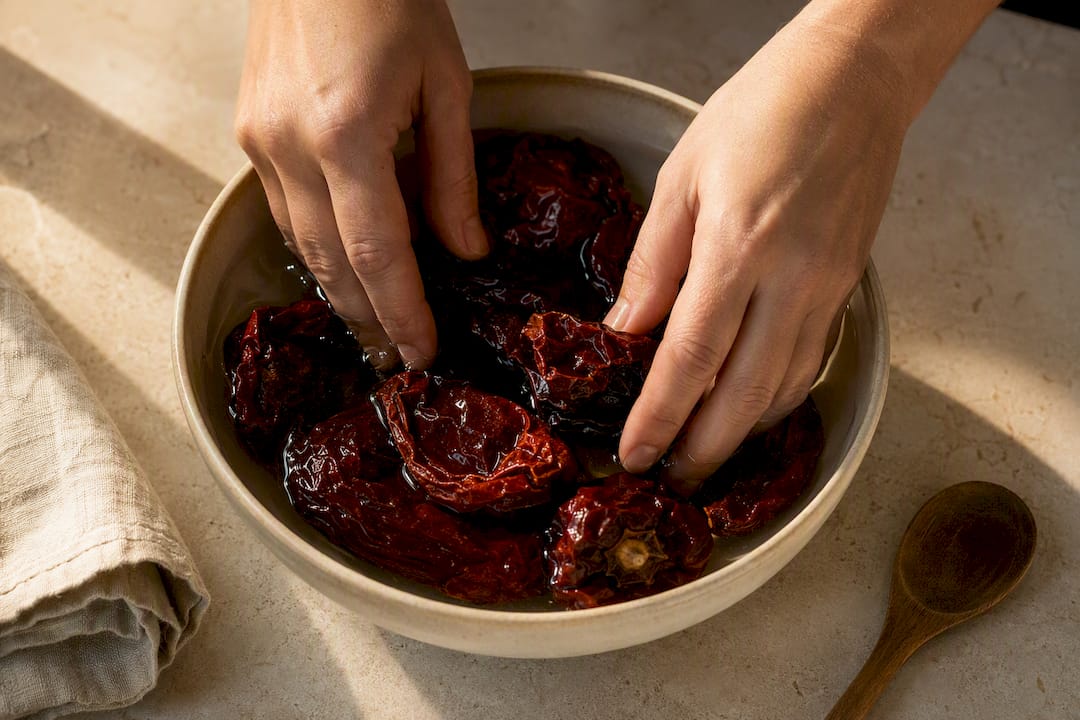
Start the ñora peppers first, since they need the longest lead time. Split them open, discard the seeds, and soak them in warm (not boiling) water for about 30 minutes until the flesh softens enough to scrape out with a spoon.
While the peppers soak, work through the rest:
- Roast the tomatoes and unpeeled garlic cloves in a 400°F oven, or char them directly in a dry pan on the stovetop, until the skins blister and the garlic turns soft, about 20 to 25 minutes for the tomatoes and closer to 15 for the garlic.
- Toast the almonds and hazelnuts in a dry skillet over medium heat until lightly colored and fragrant, shaking often to avoid scorching.
- Fry a slice of stale bread (or a couple of carquinyolis, the local almond biscuit) in a little olive oil until golden, then set aside as the thickener.
- Scrape the ñora pulp into a blender or food processor along with the roasted tomatoes, garlic, toasted nuts, and fried bread.
- Blend on low with a splash of the ñora soaking liquid to get things moving, then stream in the olive oil slowly while the machine keeps running.
- Taste, adjust with a splash of sherry vinegar and salt, and blend a final few seconds to smooth it out.
Pro Tip: Add the oil in a thin, steady stream rather than dumping it in all at once. Rushing this step is the number one reason home versions turn grainy or split instead of coming together into a creamy sauce.
The finished romesco keeps refrigerated for four to five days in a sealed container, and the flavor actually improves after the first night as the garlic and ñora mellow into the oil. It also freezes reasonably well for up to a month, though the texture is best right after a fresh blend.
What Techniques Separate Good Romesco From Great Romesco?
Catalan chefs generally agree that hydrating ñora peppers in warm water for roughly 30 minutes is non-negotiable, and rushing that step with boiling water or a microwave shortcut tends to cook the skin unevenly and leave the flesh tough. If the pulp still tastes flat after soaking, a brief reheat in a dry pan with a touch of oil can wake up the aroma. Push that step too far and the peppers turn bitter.
Emulsification is where most home versions fall apart, literally. Top Catalan chefs treat the oil-adding stage as its own skill: start the blender with solids and a little of the reserved soaking liquid, then add oil in a slow stream. Some professional kitchens spend several minutes on this step to get a sauce that holds together instead of separating into a greasy, broken mess.
A few common mistakes worth flagging:
- Too much bread turns the sauce pasty and mutes the smoky pepper flavor; use it sparingly, as a texture aid, not a base.
- Over-frying the ñora or nuts introduces bitterness that no amount of vinegar will fix.
- Blending in a hot container (right after washing with hot water, for instance) can cause the oil to separate faster than it should.
Pro Tip: If your emulsion breaks anyway, don’t panic. Scrape the sauce back into the blender, add one egg yolk or a spoonful of the ñora liquid, and re-blend on low while streaming in a little fresh oil. It usually comes back together.
What Are the Best Uses for Romesco Sauce?
Romesco earns its reputation at the grill. Traditionally it accompanies grilled or roasted fish and forms the backbone of salvitxada, the close cousin served alongside calçots during Catalonia’s spring calçotada feasts.
Beyond that classic pairing, it holds up well in less traditional settings:
- Spooned over roasted or grilled vegetables like eggplant, peppers, and potatoes.
- Served with grilled meats, standing in for a steak sauce with more character.
- Spread thin on a sandwich or crusty bread as a stand-in for aioli.
- Stirred into pasta or a roasted potato salad for a smoky, nutty base.
For dips, keep it thick. For a dressing over greens or a drizzle across grilled fish, thin it slightly with a bit more olive oil or a splash of water until it coats a spoon without clinging.
How Do You Adapt Romesco for Allergies or Pantry Limits?
Romesco is forgiving, which is part of why food historians point out there’s no single official recipe. Every Catalan family adjusts it to what they have.
- Nut-free: swap in toasted sunflower or pumpkin seeds, or lean more heavily on the bread, though the sauce loses some richness.
- No ñora available: pimiento choricero works as a near-identical substitute, or use reconstituted dried ancho chiles with a pinch of sweet smoked paprika to approximate the smoky sweetness.
- Pantry shortcut: jarred roasted red peppers plus canned tomato get you most of the way there when fresh roasting isn’t practical, especially if you compensate with good nuts and a generous, slow-added pour of olive oil.
- Vegan diners rarely need special accommodation here. Romesco is vegan by default in nearly every traditional version, since butter and dairy never enter the recipe.
How Does Aflamas Approach Romesco?
Balancing smoky ñora, toasted nuts, and a generous pour of olive oil is treated as a technique problem before it’s a flavor one. Get the emulsion wrong and no amount of seasoning saves the plate; get it right and the sauce carries a dish on its own.
In the kitchen, portioning matters as much as flavor. A thin ribbon of romesco under a piece of grilled fish reads differently than a generous swipe under roasted vegetables, and how the sauce is plated changes how a diner experiences the smokiness and richness in the first bite.
The Aflamas chef brings this kind of fire-driven, ingredient-first thinking to every tasting menu at the restaurant, treating traditional Catalan sauces like romesco as a foundation for modern plating rather than a museum piece to be copied exactly.
Taste Romesco the Way It’s Meant to Be Made
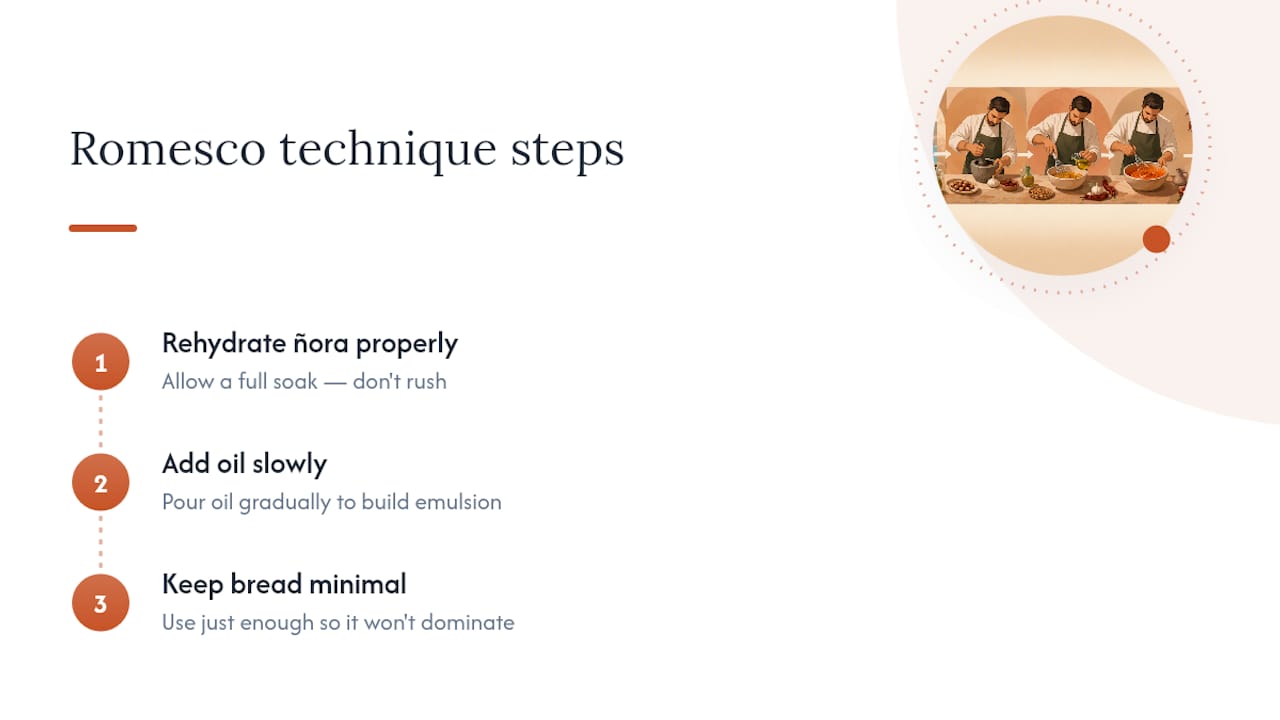
Most romesco advice online treats it like a fixed formula: exact grams, exact peppers, exact ratios. That misses the point. The Tarragona sources and the chefs cited throughout this piece agree on technique, not dogma. Rehydrate the ñora properly. Add the oil slowly. Don’t let bread do more work than it should. Those three habits matter far more than whether your almond-to-hazelnut ratio is precisely even.
Where home cooks go wrong most often isn’t the ingredient list, it’s impatience. Rushing the ñora soak or dumping oil in all at once are the two mistakes that turn an authentic sauce into a flat, greasy approximation. Fix the pace before you fix the recipe.
If you want to taste what happens when that technique is handled by people who do it daily, Aflamas builds fire-forward, ingredient-driven dishes into its tasting menu in Barcelona, where traditional Catalan technique meets a more contemporary plate. It’s worth experiencing romesco made this way at least once before judging your own kitchen version too harshly.
— YellowRock
Sources
For readers who want the deeper history and regional detail, Romesco de Tarragona documents traditional proportions and common pitfalls in depth. El País offers a chef-tested recipe with emulsification detail, and the Spanish Wikipedia entry gives useful background on regional variation.
- Los cocineros catalanes coinciden: “Para la salsa romesco es importante hidratar la ñora durante 30 minutos…” — Clara
- Salsa para calçots (romesco o salvitxada) | EL PAÍS
FAQ
What Is Romesco Sauce Made Of?
Romesco is made from roasted tomatoes and garlic, toasted almonds and hazelnuts, hydrated ñora peppers, extra virgin olive oil, and a small amount of bread or vinegar for texture and acidity.
Is Romesco Sauce Spanish or Italian?
Romesco is Spanish, specifically Catalan, originating in the fishing quarter of El Serrallo in Tarragona, where it was first made to accompany grilled fish.
What Are the Ingredients in Catalan Romesco Sauce?
The traditional ingredient list includes roasted tomatoes, roasted garlic, toasted almonds and hazelnuts, dried ñora peppers (or pimiento choricero), olive oil, and a touch of bread or vinegar, though exact proportions vary by family.
Is Romesco the Same as Salvitxada?
Romesco and salvitxada are closely related but not identical. Salvitxada is the version traditionally served with calçots and tends to be thinner and more vinegar-forward, while romesco is typically thicker and used more broadly with fish and vegetables.
How Long Does Homemade Romesco Sauce Last?
Romesco keeps refrigerated in a sealed container for four to five days, and many cooks find the flavor improves slightly after the first day as the garlic and ñora mellow.