
A rehearsal dinner works best when it stays small: immediate family, the wedding party, and maybe a few out-of-town guests, nothing more. Pick a host and lock a budget before you touch a guest list. Send invitations on the standard four to six week window, and if you want the logistics handled for you, a private-dining setup at a restaurant like Aflamas removes most of the guesswork.
TL;DR:
- Choosing a private dining room at a restaurant like Aflamas simplifies logistics with fixed pricing and menu flexibility for dietary restrictions.
- Hosting should be limited to the wedding party, immediate family, and possibly out-of-town guests if using a hybrid model, to avoid scope creep.
- The ideal timeline involves planning from four to five months out, with invitations sent four to six weeks before and RSVPs confirmed one to two weeks prior.
- Keep speeches brief, just two to three minutes, and schedule them between courses to maintain the flow and prevent the evening from running late.
- Appoint one person as the point of contact to manage day-of logistics, ensuring the event ends on time and guests have meaningful interactions.
Table of Contents
- Rehearsal Dinner Planning Timeline: Your Month-by-Month Checklist
- Rehearsal Dinner Etiquette: Dos and Don’ts for Hosts and Guests
- Choosing a Rehearsal Dinner Location and Menu
- When Should You Send Rehearsal Dinner Invitations?
- Sample Rehearsal Dinner Timeline for the Big Night
- Who Gives Speeches and When Are Gifts Presented?
- A Private Dining Room That Handles the Logistics for You
- A Planner’s Take on What Actually Matters
- Ready to Book Your Rehearsal Dinner Menu?
- Sources
- FAQ
Rehearsal Dinner Planning Timeline: Your Month-by-Month Checklist
Rehearsal dinner planning goes smoother when you work backward from the wedding date instead of scrambling the week before. The step-by-step checklist structure below breaks the work into manageable chunks, and most of it can be delegated to a parent, planner, or maid of honor.
Four to five months before:
- Decide who is hosting and hosting’s rough budget ceiling
- Draft a guest list limited to the wedding party, immediate family, and officiant
- Research two or three venues that match your headcount and tone
Two to three months before:
- Reserve the venue and put down any required deposit
- Choose the menu format and flag dietary needs early
- Collect mailing addresses and get invitations out the door
One month to two weeks before:
- Chase down outstanding RSVPs and lock the final headcount
- Confirm the menu with the venue, including any last substitutions
- Decide who is giving toasts and arrange transportation or AV equipment
Day-of checklist:
- Pack decor, place cards, and any gifts the night before
- Run a quick five-minute walk-through of who speaks and when
- Call the venue that morning to confirm timing and headcount
- Assign a timekeeper who isn’t in the wedding party
Budgeting deserves its own line item. Per-person pricing rarely reflects the final bill. Tax, service charges, and administrative fees stack on top, so build that cushion in from the start rather than discovering it on the invoice.
Rehearsal Dinner Etiquette: Dos and Don’ts for Hosts and Guests
Etiquette mistakes at a rehearsal dinner are almost always about scope creep. Somebody invites too many people, a toast runs long, or nobody figures out who’s paying until the check arrives.
Do this:
- Decide who’s hosting and paying, then say so clearly to family early on
- Keep the list to the wedding party and immediate family unless you’re intentionally running a hybrid welcome-dinner model for out-of-town guests
- Cap toasts at two to three minutes each
Skip this:
- Assuming tradition dictates who pay. Modern couples split costs, parents cover it, or either side hosts depending on family dynamics, so confirm it rather than guess
- Treating the dinner like a mini-reception with the full wedding guest list
- Letting toasts run unmoderated. A rehearsal dinner with six unscripted speeches at ten minutes apiece kills the evening before it starts
Pro Tip: Tell your speakers the time limit when you ask them to speak, not the night before. A two-minute toast feels generous; a surprise two-minute cap feels like a scolding.
Choosing a Rehearsal Dinner Location and Menu
Your venue and menu choice sets the tone for everything else, and it’s usually where budgets go sideways if nobody asks the right questions upfront.
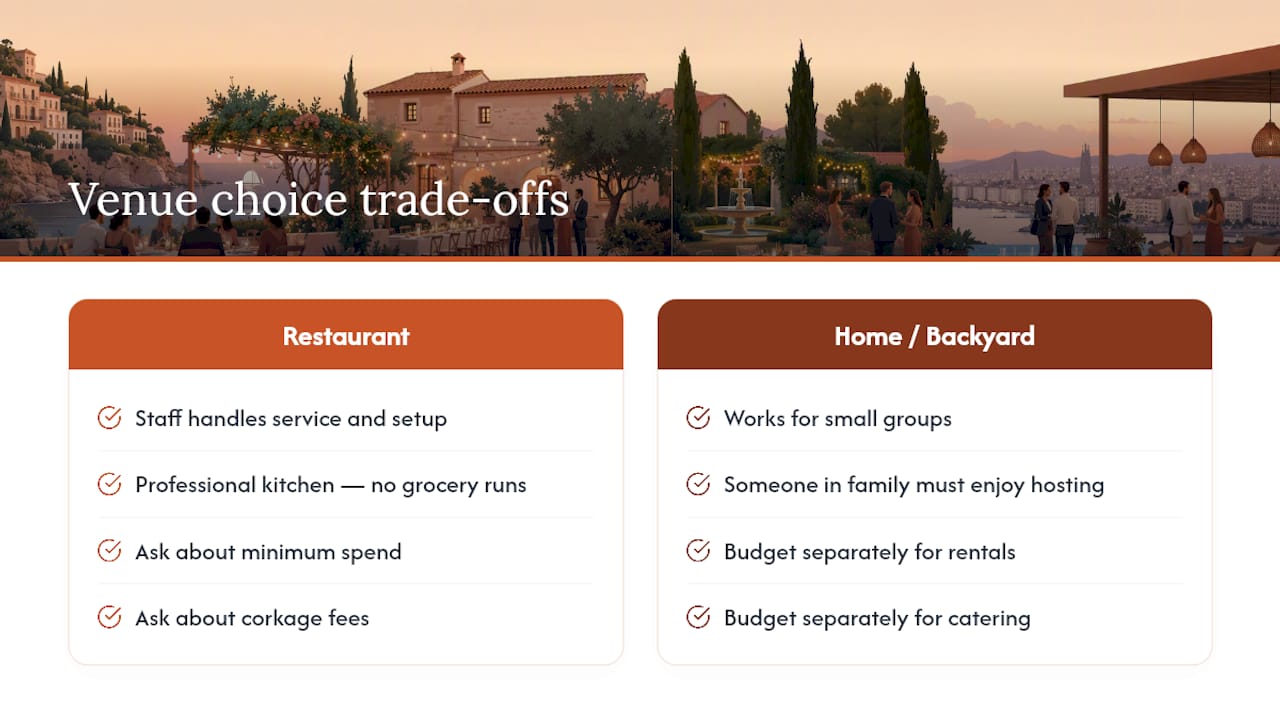
Private dining rooms at restaurants cut down on setup work since staff handle service, and a professional kitchen means no last-minute grocery runs. Before booking, ask about minimum spend, corkage fees, dessert-cutting charges, and whether they allow outside AV equipment for a slideshow or toast microphone.
Home or backyard settings work when your group is small and someone in the family actually enjoys hosting. Budget separately for rentals (tables, chairs, linens) and catering, since these costs add up fast once you’re feeding more than a dozen people.
Menu format matters more than people think. A plated prix fixe keeps timing predictable. Family-style plates encourage conversation but slow down service. A cocktail-and-appetizer format works for looser, mingling-style dinners. Whatever you pick, collect dietary restrictions during the RSVP process, not the week of the event.
When Should You Send Rehearsal Dinner Invitations?
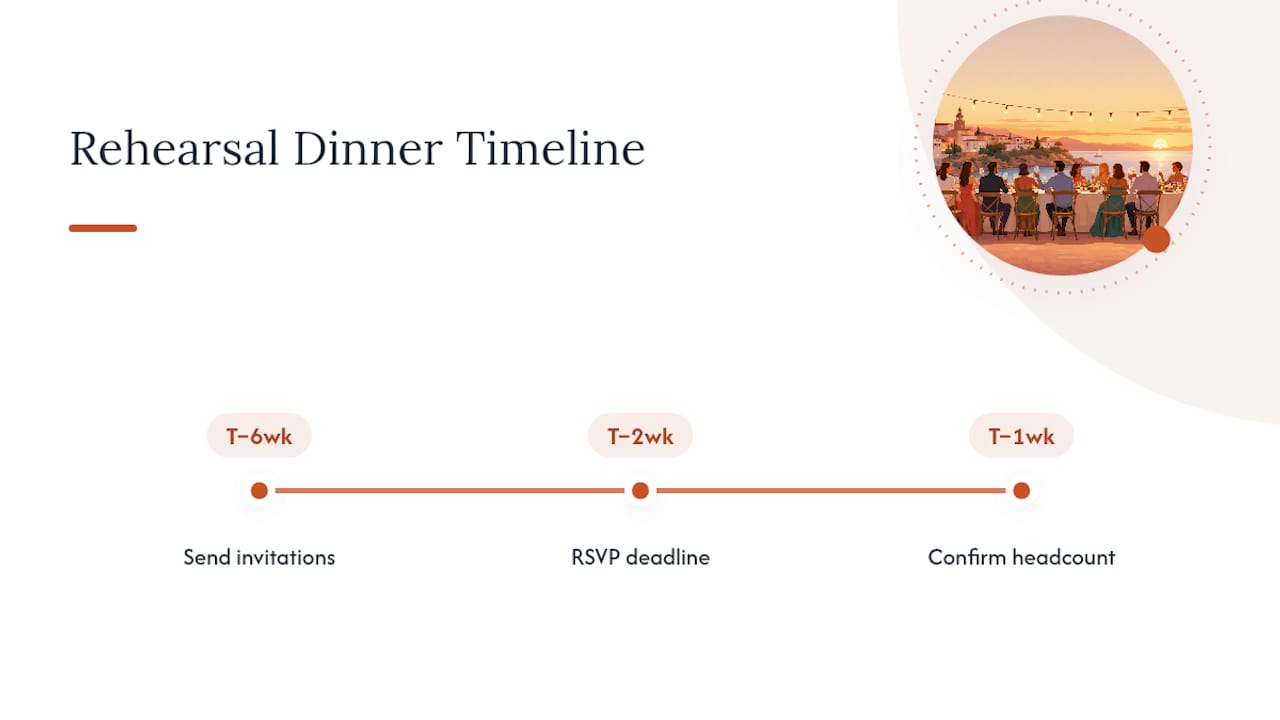
Send invitations four to six weeks before the event, and set your RSVP deadline one to two weeks out so you can confirm a final headcount with the venue before final menu numbers lock in.
Every invitation, whether digital or printed, needs the date, time, venue address, dress code, an RSVP contact, and a line asking guests to flag dietary restrictions. Digital invites work fine for a casual dinner; printed ones fit if you’re already sending formal wedding stationery and want the set to match.
If RSVPs go quiet a few days before your deadline, a short personal text works better than a mass email: “Hey! Just finalizing headcount for the rehearsal dinner. Can you confirm by Friday?”
Sample Rehearsal Dinner Timeline for the Big Night
The rehearsal dinner typically follows the ceremony rehearsal the evening before the wedding, though scheduling it up to a week earlier is completely acceptable if logistics demand it.
- 4:30 to 5:30 PM — Ceremony rehearsal at the venue or church
- 5:30 to 6:00 PM — Travel buffer to the dinner location
- 6:00 to 6:45 PM — Cocktail hour and mingling
- 6:45 PM — Dinner service begins
- 7:30 to 8:00 PM — Toasts, gift presentation
- 8:30 PM — Wrap-up and departure
Budget roughly 45 minutes per course for a plated dinner, and schedule toasts between the main course and dessert so nobody’s giving a speech to an empty plate. Appointing a timekeeper who isn’t in the wedding party keeps course changes and toasts moving without anyone feeling rushed by their own family.
Who Gives Speeches and When Are Gifts Presented?
The typical speaking order runs host first, then parents, then close friends or siblings, and the couple last if they choose to speak at all. Keep each speech to two or three minutes; the rehearsal dinner is a lower-pressure stage than the wedding reception, so nervous speakers can write notes and read from them without anyone blinking.
- Present gifts to the wedding party after toasts, before dessert
- Keep attendant gifts practical: a nice flask, jewelry, or something usable on the wedding day itself
- Parent gifts tend to run more sentimental: a framed photo, a handwritten letter, a small keepsake
A Private Dining Room That Handles the Logistics for You
Aflamas offers private dining rooms in Barcelona built for exactly this kind of celebration, with group menus that flex around vegetarian, vegan, gluten-free, and lactose-free guests without extra hassle. Ask any venue about menu flexibility, AV compatibility, minimum spend, and deposit or cancellation terms. Restaurant private dining removes the setup and cleanup work entirely.
A Planner’s Take on What Actually Matters
The rehearsal dinner that people remember fondly isn’t the one with the most elaborate decor. It’s the one that ended on time, fed everyone well, and let the couple actually talk to their families instead of running logistics. Appoint one person, not the couple, as the point of contact for day-of changes. Guests forgive a simple menu. They don’t forgive a dinner that runs two hours past when it should have wrapped.
— YellowRock
Ready to Book Your Rehearsal Dinner Menu?
A private dining route can skip the venue-hunting, rental quotes, and DIY catering math altogether with a dedicated room, a chef-driven menu, and accommodation for various dietary needs. The Alma, Fuego, and Pasión group menus start at fixed per-person prices, so your budget is locked before the night even starts, and the kitchen handles dietary substitutions without a separate conversation. For couples still comparing tasting menus, the Menú Selección Autor works well for a smaller, more intimate group. Reach out a few weeks ahead of your date through the group menu inquiry page to confirm availability and finalize your headcount.
Sources
- How to plan a rehearsal dinner | Brides
- Your Step-by-Step Rehearsal Dinner Checklist to Help You Plan Like a Pro | The Knot
- Wedding rehearsal dinner etiquette | WeddingVenture
- The rehearsal dinner | Emily Post
FAQ
What Is the Typical Schedule for a Rehearsal Dinner?
Most rehearsal dinners run about three to four hours total, starting right after the ceremony rehearsal with a cocktail hour, followed by dinner, toasts, and an early wrap-up. A sample schedule might run rehearsal at 4:30 PM, cocktails at 6:00 PM, dinner at 6:45 PM, and toasts around 7:30 PM.
What Is the Protocol for a Rehearsal Dinner?
The standard protocol keeps the guest list to the wedding party and immediate family, limits speeches to two to three minutes each, and follows the ceremony rehearsal the night before the wedding. Scheduling it up to a week earlier is also acceptable when logistics require it.
Who Is Supposed to Plan the Rehearsal Dinner?
There’s no fixed rule: the couple, either set of parents, or a split arrangement between families can all host and pay. The key is deciding early and telling everyone involved so nobody assumes a different arrangement.
What Are the Trends for Rehearsal Dinners in 2026?
More couples are pairing a small, focused rehearsal dinner with a separate welcome-drinks event for larger out-of-town guest lists, keeping the core dinner intimate while still greeting travelers. Private dining rooms at restaurants are also gaining ground over backyard setups, since they cut setup work and put menu flexibility in professional hands.
Does Aflamas Offer Private Dining for Rehearsal Dinners?
Yes. Aflamas provides private dining rooms in Barcelona with group menus starting at fixed per-person prices, fully adaptable for vegetarian, vegan, gluten-free, and lactose-free guests.