Prix fixe means a fixed price for a short, structured meal where you still pick each course; a tasting menu means the chef picks almost everything, across more courses, to tell one continuous story on the plate. The practical fallout: prix fixe usually runs 90 minutes to two hours and leaves room for conversation, while a tasting menu can stretch past three hours and asks you to hand over control. Everything below breaks down the differences, the costs, and how to know which one fits your night.
TL;DR:
- Choose a prix fixe menu if your evening demands a shorter, more flexible meal with predictable pacing and menu options, especially for social or casual occasions.
- Opt for a tasting menu when seeking an immersive experience that showcases the chef’s technique and storytelling, typically suited for special celebrations or food-focused nights.
- Budget for a tasting menu that can range from $65 to over $250 per person, with longer, multi-hour experiences often including wine pairings that increase the total cost.
- Be aware that tasting menus often require advance dietary notices, have limited substitution flexibility, and can stretch from two to five hours depending on course count.
- Check the menu’s course count and duration when booking to ensure it aligns with your time constraints, dietary needs, and the type of experience you desire.
Table of Contents
- Prix Fixe vs Tasting Menu: The Direct Comparison
- What Is a Prix Fixe Menu?
- What Is a Tasting Menu, and How Is It Different?
- When Should You Choose Prix Fixe vs Tasting Menu?
- How Much Should You Budget, and How Long Will Dinner Take?
- What to Expect: Etiquette for Each Format
- How Are Dietary Restrictions and Substitutions Handled?
- Aflamas: A Modern Tasting-Menu Restaurant in Practice
- Where Did Prix Fixe and Tasting Menus Actually Come From?
- Which Restaurants Actually Use Each Format?
- The Real Tradeoffs for Diners and Restaurants
- Iconic Examples That Show the Contrast
- A Practical Take on Choosing Between the Two
- Book the Tasting Menu Experience at Aflamas
- Sources
Prix Fixe vs Tasting Menu: The Direct Comparison
The two formats solve different problems. Prix fixe gives you guardrails with some freedom inside them. A tasting menu removes the freedom and replaces it with a single, deliberate arc from the kitchen.
- Choice: Prix fixe lets you pick one dish per course from a short list; tasting menus offer little or no choice beyond dietary substitutions.
- Course count: Prix fixe typically runs 2 to 5 courses, while tasting menus can span 5 to 20 or more.
- Portion size: Prix fixe portions resemble standard à la carte plates; tasting menu portions shrink dramatically so 12 courses don’t add up to three dinners.
- Pacing and duration: Prix fixe moves faster and predictably; tasting menus are paced by the kitchen, with longer gaps built in for plating and presentation.
- Price structure: Prix fixe usually quotes one flat number per person; tasting menus often separate the food price from an optional wine pairing, which can double the bill.
- Occasion fit: Prix fixe suits conversation-first nights; tasting menus suit food-first nights where the meal is the event.
Think of prix fixe as a curated menu with training wheels still on, and a tasting menu as the chef taking the wheel entirely. Neither is objectively better. They’re built for different evenings.
What Is a Prix Fixe Menu?
“Prix fixe” is French for “fixed price,” and that’s exactly what you’re paying: one number covers a set number of courses, usually two to five, each with two or three options to choose from. It’s the format you’ll recognize from restaurant week promotions, pre-theater dinners, and Sunday brunch specials.
Restaurants love prix fixe for reasons that have nothing to do with romance and everything to do with logistics:
- Predictable food costs. Limited options mean the kitchen can forecast exactly what to prep, cutting waste.
- Faster table turns. Fewer courses and simpler timing let a dining room seat more guests per night.
- Lower kitchen strain. Smaller teams can execute a tight menu well instead of a sprawling one poorly.
- Easier substitutions. Because each course still has options, swapping a dish for a dietary need rarely disrupts the whole meal.
Portion sizes stay close to normal entrée scale, and pacing feels like a regular dinner, just with the ordering decisions narrowed down. When you book, it’s worth asking whether add ons, like a cheese course or a supplemental appetizer, cost extra. Most prix fixe menus post substitution policies clearly, since operational simplicity is the whole point of the format.
What Is a Tasting Menu, and How Is It Different?
A tasting menu is a chef’s fixed sequence of small courses, built to move through flavors, textures, and techniques in a specific order rather than let you assemble your own meal. It’s a distant cousin of prix fixe in that both are set prices, but the resemblance stops there once the plates start arriving.
Course counts run wide: some restaurants serve a tight 5 to 7 courses, while ambitious kitchens push past 12, occasionally into the 20-course range. Each portion is deliberately small, sometimes just a few bites, because the point is breadth of experience, not volume of food. That calibration is what makes 15 courses feel reasonable instead of absurd.
Chefs favor tasting menus because the format gives them something prix fixe can’t: total narrative control. A flavor progression built across a dozen courses lets the kitchen showcase technique, seasonal ingredients, and pacing in a way a three-course dinner simply can’t hold.
- Substitutions are more limited than prix fixe, since courses are often designed to build on each other.
- When a swap is needed, many kitchens replace an entire sequence rather than one isolated dish.
- Dietary notice typically needs to happen well before the reservation, not at the table.
- Pacing is set by the kitchen, so the meal unfolds on its schedule, not yours.
The tradeoff is straightforward: you give up choice, and in exchange you get a meal that’s harder to replicate anywhere else.
When Should You Choose Prix Fixe vs Tasting Menu?
Match the format to what the evening actually needs, not just what sounds fancier. A first date or a business dinner benefits from prix fixe because conversation matters more than ceremony, and a shorter, choice-friendly meal keeps things moving. A birthday, anniversary, or “we’re celebrating something” dinner is exactly when a tasting menu earns its longer runtime, since the food itself becomes the shared experience.
Run through this before you book:
- How much time do you actually have? Under two hours, lean prix fixe. Open evening, tasting menu works.
- Who’s at the table? Mixed group with picky eaters or dietary needs, prix fixe is more forgiving.
- Is talking or eating the priority? Conversation-heavy nights want fewer interruptions; food-focused nights want the full sequence.
- What’s your ceiling on cost? Add wine pairings to a tasting menu and the bill can climb well past the base price.
- Do you want a quick, satisfying meal or an event? Be honest about which one you’re actually craving.
Pro Tip: If you’re on the fence, book the tasting menu for the celebration and save prix fixe for the “let’s just catch up over dinner” nights. Save yourself the difficulty of asking a table of six to commit to 12 courses when half of them have a 9 a.m. flight.
How Much Should You Budget, and How Long Will Dinner Take?
Base prices vary a lot by market and prestige, but as planning references, compact tasting menus often land $65 to $130, standard menus $130 to $250, and extended menus $250 and up. Prix fixe menus typically sit lower, since fewer courses and simpler prep keep costs down.
Budget reality check: A $150 tasting menu paired with a $100 wine flight can push your real per-person cost well past $250 once tax and gratuity land on top. Always check whether service is already included in the quoted price before you assume the number on the menu is the number on your card.
Duration follows course count closely. A short three-course prix fixe runs about 90 minutes. A typical 7 to 12 course tasting menu takes 2 to 3 hours, and anything past 12 courses can stretch to 3.5 to 5 hours. Book your evening with that math in mind, not the length of a normal dinner reservation.
What to Expect: Etiquette for Each Format
Service style shifts noticeably between the two. Prix fixe servers explain dishes briefly and move at a normal restaurant pace. Tasting menu servers narrate each course as it lands, since part of the format’s value is understanding what you’re eating and why.
- Ask questions between courses rather than mid bite. There’s a natural pause built into the pacing.
- Let empty plates signal you’re ready for the next course during a tasting menu.
- Check your bill or the booking confirmation for included gratuity before tipping again.
- Arrive on time. Tasting menus especially are timed to start together, and a late arrival can throw off the kitchen’s rhythm for your whole table.
How Are Dietary Restrictions and Substitutions Handled?
Prix fixe handles allergies and preferences more easily since each course already offers choices. Tasting menus often need an alternate sequence built in advance rather than a single swapped dish.
- Notify the restaurant when you book, not when you sit down.
- Ask directly whether vegan, vegetarian, or gluten-free versions follow the same course count.
- For mixed-diet groups, confirm each guest’s needs separately so the kitchen can plan one coherent set of substitutions instead of scrambling table side.
Aflamas: A Modern Tasting-Menu Restaurant in Practice
A useful way to see this comparison in action is to look at how a working kitchen structures it. A fine dining restaurant in Barcelona runs its dining experience almost entirely on the tasting-menu model, built around fire-based technique and local ingredients rather than an à la carte list.
The restaurant offers a Signature Menu as its core multi-course experience, a rotating Seasonal Menu that shifts with what’s available, and a dedicated Group Menu for private events and larger parties. Dietary accommodation is built into the structure rather than bolted on. Aflamas lists vegetarian, vegan, gluten-free, and lactose-free adaptations directly on its tasting menu page, which is exactly the kind of detail worth checking on any restaurant’s site before you book. Confirming duration, substitution policy, and pricing ahead of time can save you from surprises once you’re seated.
Where Did Prix Fixe and Tasting Menus Actually Come From?
Prix fixe traces back to 19th-century Parisian restaurants and tables d’hôte, where a fixed price for a set sequence of courses let establishments serve large numbers of diners efficiently during a defined dinner service. It was, at its core, a pricing innovation before it was a culinary one: predictable revenue for the house, predictable cost for the guest.
The tasting menu has a different lineage. It grew out of the menu dégustation tradition in French haute cuisine, where chefs began offering smaller portions of multiple dishes so diners could sample a broader range of a kitchen’s technique in one sitting. The format gained serious momentum in the late twentieth century as chefs like those associated with nouvelle cuisine started treating a meal less like a list of separate dishes and more like a single composed work. Spanish avant garde cooking pushed the idea further still, turning tasting menus into something closer to a structured performance, course by course, than a conventional dinner.
Both formats spread globally because they solved real problems: prix fixe made fine dining accessible and efficient, while tasting menus gave ambitious chefs a stage large enough to show real range. The cultural association that lingers today, prix fixe as approachable and tasting menu as an occasion, comes directly from those separate origins rather than any arbitrary marketing decision.
Which Restaurants Actually Use Each Format?
Prix fixe shows up wherever a kitchen needs to balance quality with volume. Bistros, brasseries, hotel restaurants, and pre-theater dining rooms lean on it constantly, since it lets them serve a full house without losing consistency. Restaurant week promotions in most major cities run almost entirely on prix fixe pricing, because it gives new customers an easy, lower-risk way to try a kitchen they haven’t visited before.
Tasting menus cluster at the higher end of the spectrum: chef-driven fine dining, restaurants built around a specific culinary point of view, and kitchens where the meal itself is the draw rather than a backdrop for a business meeting. Contemporary and avant garde restaurants, especially those working with techniques like fermentation, live fire, or foraged ingredients, favor tasting menus because the format lets each course function as a small argument for the chef’s approach. Sushi omakase counters use a close cousin of the tasting menu for the same reason: sequence and pacing matter as much as any individual piece of fish.
There’s overlap, too. Some restaurants run both formats simultaneously, a shorter prix fixe for weeknight diners and a longer tasting menu for guests who want the full experience, which lets one kitchen serve two very different kinds of evenings without changing its identity.
The Real Tradeoffs for Diners and Restaurants
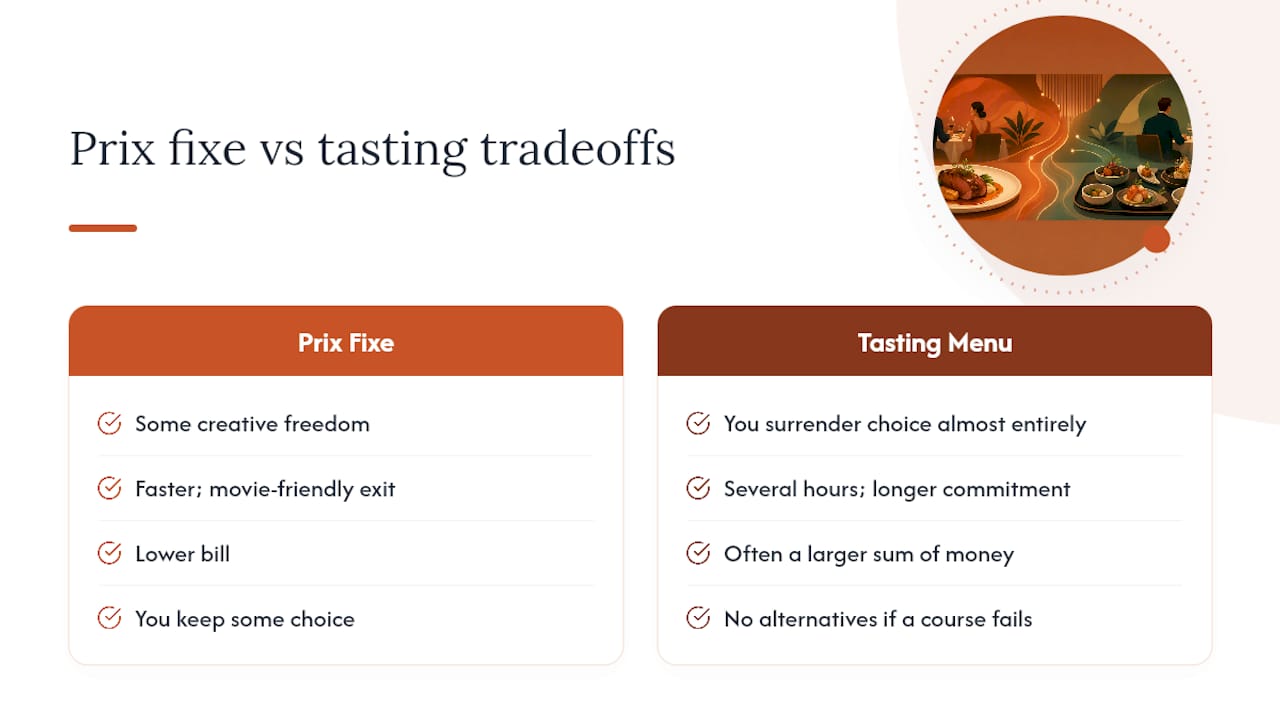
For diners, prix fixe trades some creative freedom for speed, predictability, and a lower bill. You know roughly what you’re getting, you keep some say in the matter, and you’re out the door in time for a movie. The downside is that you rarely get the kitchen’s most ambitious work. Prix fixe menus are built to be reliable, not experimental.
Tasting menus flip that equation. You surrender choice almost entirely, and you’re committing several hours and often a larger sum of money to the experience. In exchange, you get the chef’s most considered ideas, presented in the order the chef believes tells the best story. The risk is real too: if one course misses for your palate, there’s often no alternative waiting, and dietary restrictions can complicate the sequence more than they would on a prix fixe list.
For restaurants, the calculus runs in the opposite direction. Prix fixe is the easier format to execute at scale. It reduces waste and speeds table turns, which matters enormously for a restaurant trying to fill a dining room on a Tuesday. Tasting menus demand more from the kitchen: tighter timing, more specialized labor, and a much smaller margin for error, since a single weak course can undercut an entire multi hour narrative. The payoff for restaurants willing to take that risk is differentiation. A memorable tasting menu becomes a reason people book a table months in advance, not just a place to grab dinner before a show.
Iconic Examples That Show the Contrast
A few real-world reference points make the difference between formats concrete. Classic Parisian bistros have run three-course prix fixe menus for generations, typically a starter, a main, and a dessert with two or three choices at each step, priced to move diners through efficiently during a set service window. That structure hasn’t changed much in over a century, because it still works exactly as intended.
On the tasting menu side, restaurants associated with the elBulli lineage in Spain pushed the format toward its most experimental extreme, serving 20 or more small courses built around unexpected textures and techniques, turning dinner into something closer to a multi-hour tasting event than a meal in the traditional sense. Contemporary fine dining kitchens working with fire and seasonal ingredients often land somewhere in between, offering 7 to 12 course sequences that give diners a clear narrative arc without stretching into five-hour territory.
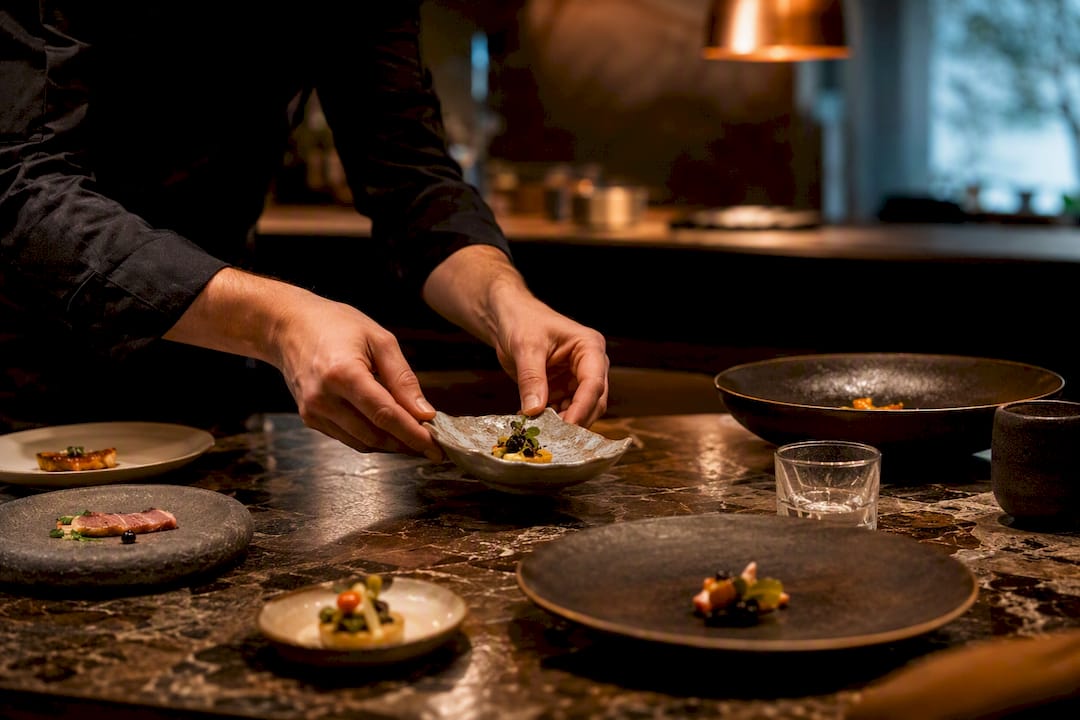
The gap between a bistro’s three-course prix fixe and a 20-course avant garde tasting menu isn’t just about course count. It’s a completely different idea of what a restaurant meal is supposed to accomplish, one built for efficient enjoyment, the other built for total immersion.
A Practical Take on Choosing Between the Two
Most diners overthink this decision. If you want food to be the centerpiece of the night and you’ve got the hours to give it, book the tasting menu and don’t second-guess it. If you need the meal to serve conversation rather than dominate it, prix fixe wins every time. Before booking anywhere, including Aflamas, check the posted course count and duration so your evening’s pacing actually matches your plans.
— YellowRock
Book the Tasting Menu Experience at Aflamas
If you’ve decided the story-driven, multi-course format is what you want, a restaurant in Barcelona offers a kitchen built around exactly that idea, contemporary technique, live fire, and local ingredients arranged into a single sequence rather than a list of separate dishes. Every version of the menu, from the Signature Menu to the rotating Seasonal Menu, comes with clearly listed vegetarian, vegan, gluten-free, and lactose-free adaptations, so mixed-diet groups don’t have to negotiate substitutions at the table.
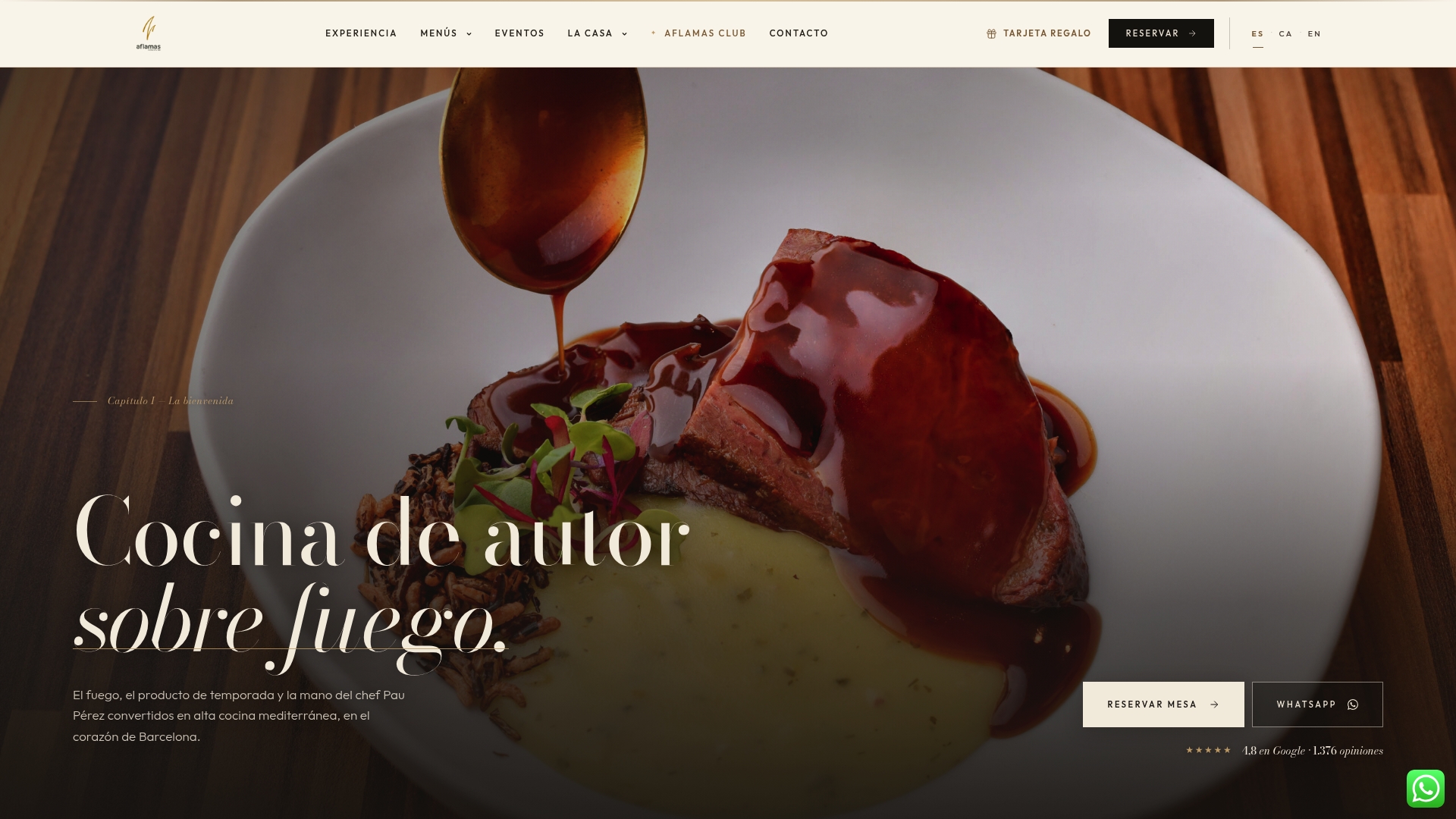
For celebrations or larger parties, the Group Menu covers private events without forcing everyone into identical choices. Reserve through the tasting menu page, and confirm your course count, expected duration, and any dietary notes when you book so the kitchen can plan your table’s sequence in advance.
Sources
- The Tasting Menu Experience: What to Expect Course by Course | Fine Dining Authority
- Prix fixe vs tasting menu difference | Restaurants for Kings
- Tasting Menu Etiquette: What to Expect at Your First One | Tasting Menu Toronto