Open kitchen dining puts you in direct view of a chef-led tasting menu as it’s prepared, usually at a counter, chef’s table, or semi-open seating area. It suits diners who want an immersive, technique-forward meal rather than a quiet corner table: food-focused eaters, couples celebrating something, and small groups who like watching a plate come together. Expect a reservation-only setup, a fixed or near-fixed menu, and a longer, more theatrical meal than standard dining.
TL;DR:
- Open kitchen dining typically involves small seating capacities, fixed menus, and a longer, theatrical experience centered around live plating and ingredient storytelling.
- Booking requires advance planning to confirm menu type, group size, dietary restrictions, and timing, as seats often sell out weeks ahead, especially for weekend dates.
- Diners must maintain respectful behavior: moderate noise, ask questions politely, and communicate dietary needs well in advance due to the fixed menu and ingredient restrictions.
- The format emphasizes transparency and safety, with staff adhering to high standards of cleanliness and ventilation, and visible handling of ingredients and cross-contact prevention.
- Cuisines that highlight visual cooking techniques, like fire-based or sushi, tend to prefer open kitchens, which enhance storytelling and trust while amplifying service challenges for chefs.
Table of Contents
- What Is Open Kitchen Dining, and What Happens During the Meal?
- How Do You Choose and Book an Open-Kitchen Table?
- What Etiquette and Accessibility Rules Apply at an Open Kitchen?
- How Do Group and Private Dining Options Differ Here?
- Why Do Diners Choose the Open-Kitchen Format?
- What Health and Safety Standards Apply to Open Kitchens?
- What Are the Benefits and Challenges of Open Kitchen Dining?
- Which Cuisines and Restaurant Styles Lean on Open Kitchens?
- What Should a Well-Designed Open Kitchen Dining Space Consider?
- How We Handle Open-Kitchen Dining at Aflamas
- Ready to Book Your Open-Kitchen Table at Aflamas?
- Sources
- FAQ
What Is Open Kitchen Dining, and What Happens During the Meal?
Open kitchen dining is built around a sequenced tasting menu rather than an à la carte spread. You’ll typically move through an opening bite or two (often called an amuse-bouche), several courses that build in intensity, a palate cleanser somewhere in the middle, and a dessert sequence at the end. The kitchen isn’t hidden behind a wall. It’s part of the room.
Seating tends to fall into three formats. Counter seating puts you shoulder to shoulder with other diners, facing the pass directly. A U-shaped chef’s table wraps around the cooking station so everyone gets a sightline. Semi-private enclaves pull a small group slightly apart from the main room while still keeping a partial view of the kitchen. Each changes how much you hear and see, and how much you interact with the cooks themselves.
Chef’s-table and open-kitchen formats generally seat small groups or counter patrons and build the evening around a fixed tasting menu with courses arriving in a set order rather than on request. A full seating usually runs several hours, with a deliberate pacing where each course is served only after the previous one has settled.
What you’ll actually witness varies by restaurant, but common elements include:
- Live plating at the pass, often narrated by the chef or a server
- The sound of open flame, searing, or knife work as part of the ambient experience
- Direct eye contact and occasional conversation with the cooking team
- Small, deliberately limited seat counts that keep the format intimate rather than crowded
- Ingredient reveals tied to the season, sometimes shown before they’re cooked
That last point on capacity matters more than it sounds. Because the kitchen team is also your entertainment, most venues cap these seats well below their total dining room capacity, which is exactly why booking ahead matters.
How Do You Choose and Book an Open-Kitchen Table?
Booking a chef’s-table or open-kitchen seat takes more upfront thought than a standard reservation, mostly because the menu and the seating are both fixed in ways a normal table isn’t. Work through this before you call or click reserve:
- Confirm the menu type. Ask whether the entire table must order the same tasting menu or whether individual variations are allowed. Some of the most exclusive chef’s-table seats require every guest at that seating to take the same multi-course menu, with no à la carte fallback.
- Check the price band. Tasting menus at open-kitchen venues typically run higher per head than standard dining because you’re paying for technique, ingredients, and a longer service window, not just a plate of food.
- Ask about capacity and group policy. Counter seats and chef’s tables often seat far fewer people than the main room, so confirm whether your group size fits the format you want.
- Review cancellation terms. Fixed-menu bookings often carry stricter cancellation windows than a regular table because the kitchen has already planned ingredient quantities around your seat.
- Nail down timing. Ask how long the seating runs and what time you’re expected to arrive, since late arrivals can throw off a sequenced service for the whole table.
At the booking stage, also ask directly: how allergies are handled, whether supplements apply for premium courses, and whether the team gives verbal explanations of each dish as it arrives. Confirm accessibility needs and the venue’s photography policy while you’re at it. Some kitchens are relaxed about phones; others ask you to keep flash off or skip photos entirely during live plating.
Pro Tip: Book earlier than you think you need to. High-end chef’s-table seats, especially smaller, intimate setups with a fixed-menu requirement, can sell out weeks ahead for weekend dates, and last-minute exceptions for celebrations are the exception, not the rule.
What Etiquette and Accessibility Rules Apply at an Open Kitchen?
Sitting close to working chefs changes the social contract a little. You’re a guest at their table in a real sense, and small courtesies go further here than at a typical restaurant.
Do: keep conversation at a moderate volume so it doesn’t carry into the kitchen, ask questions about technique or ingredients when the chef offers an opening, and follow the pace the kitchen sets rather than rushing a course. Don’t: lean over the pass, snap flash photography during active plating without asking, or arrive late and expect the sequence to pause for you.
Dietary needs to deserve special attention in this format. Communicate allergies and restrictions well before your visit rather than at the table. Fixed tasting menus are planned around exact ingredient counts, so on-the-spot substitutions are harder here than at a menu-driven restaurant, and cross-contact risk is worth asking about directly if you have a serious allergy.
If mobility devices or extra seating space are a concern, mention it when you book rather than when you arrive. Counter seating and tight chef’s tables aren’t always built with wide aisles in mind, and venues can usually adjust if they know ahead of time. It’s also fair to glance at visible hygiene practices, gloved handling near raw proteins, clean workstations, and ask a polite question if something seems off. A transparent kitchen invites that kind of scrutiny by design.

How Do Group and Private Dining Options Differ Here?
Groups have three realistic paths at most open-kitchen venues: a private chef’s table booked exclusively for your party, reserved counter seating within the regular service, or a semi-private space that keeps some visual connection to the kitchen without full separation. Each comes with different flexibility and cost.
Private and group bookings typically carry their own rules, separate from a standard two-top reservation:
- Minimum guest counts, often starting somewhere between six and ten people for a private chef’s table
- Deposits required to hold the date, with the balance due closer to or on the event
- Set menus preordered for the whole group rather than individual selections
- Supplement charges for premium ingredients or added courses beyond the base menu
If you’re planning an event, confirm the flow of service (how many courses, how long the seating runs), any AV or privacy needs for speeches or presentations, and how payment is handled, one bill or split. For mixed dietary groups, ask whether the kitchen can build parallel vegetarian, vegan, or gluten-free tracks within the same sequenced service, since this is usually easier to arrange with advance notice than at the door.
Why Do Diners Choose the Open-Kitchen Format?
Watching a dish get built changes how it tastes. That’s not a marketing line, it’s a documented effect of hospitality design: seeing the technique behind a plate shifts perception of craft and value before the first bite even happens. Open kitchens also build trust simply by being visible. You can see how proteins are handled, how clean the line is, and how the team communicates under pressure.

The best chefs use that visibility to narrate. A seasonal ingredient gets introduced, shown raw, then followed through each stage of preparation, turning dinner into something closer to a story than a transaction. This format earns its price tag most clearly at celebrations and for diners who genuinely want to understand what’s happening on the plate, not just eat it.
What Health and Safety Standards Apply to Open Kitchens?
An open kitchen doesn’t get a pass on food safety just because it’s visible. If anything, the format holds staff to a higher standard because diners can watch temperature control, cross-contact prevention, and sanitation happen in real time.
Commercial kitchens, open or closed, operate under standard food-safety codes covering proper cooking and holding temperatures, handwashing protocols, allergen separation, and surface sanitation between tasks. What changes with an open layout is exposure: heat, smoke, and open flame sit closer to the dining room, so ventilation and fire suppression systems typically need to meet a higher bar than a kitchen tucked behind a wall. Noise and heat management also become guest-experience issues, not just back-of-house ones, since diners are sitting close enough to feel both.
Cross-contact control gets more visible scrutiny too. When you can watch a cook switch from a shellfish dish to a vegetarian one, you notice whether gloves change and whether cutting boards get swapped. That transparency is part of why communicating allergies in advance matters so much here: a well-run open kitchen plans its sequence around known restrictions rather than improvising mid-service. Ask about their approach if it’s a serious concern. A confident, specific answer is a good sign; a vague one isn’t.
What Are the Benefits and Challenges of Open Kitchen Dining?
For diners, the upside is obvious: theater, transparency, and a closer relationship with the food than a closed kitchen ever offers. You get real-time answers to questions about technique, ingredients, and sourcing, and a fixed tasting menu removes the decision fatigue of a long menu. The tradeoff is flexibility. Fixed menus mean less room for substitutions, seating is limited, and the noise and heat of an active kitchen aren’t for everyone, especially on a longer, multi-hour seating.
For chefs and kitchen teams, an open layout raises the stakes. Every plating mistake, every raised voice during a rush, happens in front of paying guests instead of behind a door. That pressure can sharpen a team’s discipline, but it also means service has to stay composed even when the kitchen is genuinely under strain. Staffing an open kitchen well requires cooks who can talk to guests without losing focus on the food, a skill that isn’t universal even among talented chefs.
The tradeoff generally favors venues that commit fully to the format rather than treating it as a design gimmick. A half-open kitchen with no real interaction gives you the noise without the value; a fully committed chef’s table gives you both the show and the substance.
Which Cuisines and Restaurant Styles Lean on Open Kitchens?
Fire-focused and technique-driven cuisines tend to gravitate toward open kitchens more than others, largely because the cooking itself is visually compelling. Wood-fired and grill-centric restaurants show off live flame work. Sushi counters have used open preparation for generations, with chefs slicing and plating directly in front of guests. Contemporary tasting-menu restaurants across many cuisines, French technique, Nordic-influenced seasonal cooking, modern Mediterranean, increasingly build chef’s tables or counter seating into their core format rather than treating it as a specialty add-on.
The common thread isn’t a specific cuisine. It’s restaurants where the cooking process itself has narrative value, where a chef explaining a dish adds something the plate alone doesn’t communicate. That’s as true of a live charcoal grill as it is of a precise, multi-step tasting sequence built around seasonal, fire-based technique.
What Should a Well-Designed Open Kitchen Dining Space Consider?
Good open-kitchen design starts with sightlines. Every seat should have a genuine view of the action, not a partial glimpse blocked by a hood or a server station. Counter height matters too: guests need to see the pass without craning, and the kitchen team needs workspace that doesn’t feel cramped by an audience.
Acoustics deserve as much attention as visuals. Hard surfaces near an active kitchen amplify clatter and flame noise, so well-designed spaces use sound-dampening materials in the dining area to keep the energy lively without becoming exhausting. Ventilation has to handle both heat and smoke without blowing directly on nearby diners, a detail that separates a comfortable chef’s table from an uncomfortable one fast. Layout also has to account for staff movement. Cooks need clear paths to plate and deliver without squeezing past guests, which is why the best open-kitchen rooms are designed around workflow first and seating second, not the other way around.
How We Handle Open-Kitchen Dining at Aflamas
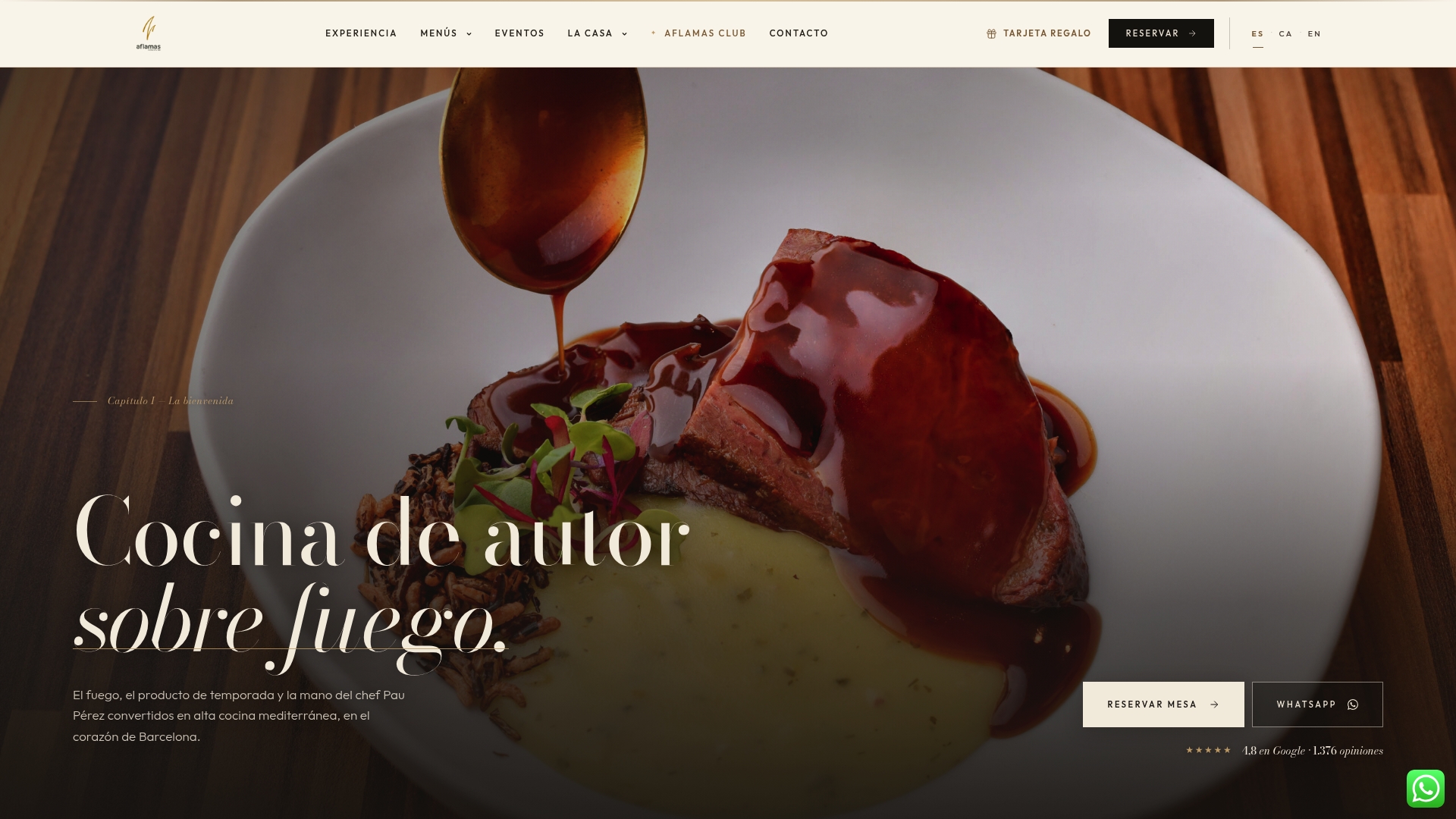
At Aflamas, our fire-based cooking sits at the center of the room, not behind it. Every tasting menu is built around live technique, seasonal and local ingredients, and full accommodation for vegetarian, vegan, gluten-free, and lactose-free diets when you tell us in advance. Booking is straightforward through our tasting menu page, and group or private event menus can be customized once we know your headcount and dietary mix.,
— YellowRock
Ready to Book Your Open-Kitchen Table at Aflamas?
This restaurant offers a chef’s-table experience focused on fire-driven tasting menus with visible technique and dietary flexibility. If you want an entry point, the Menú Ejecutivo starts at €35 per person, while the Menú Selección Autor at €90 goes deeper into our chef-driven signature courses.
For celebrations or larger parties, our group menus, Alma, Fuego, and Pasión, starting from €45, €65, and €95 per person respectively, are built for shared tables that still keep everyone facing the fire. Planning something bigger or more private? The Menú Grupos page covers our event options directly. Prefer to gift the experience instead? A gift card lets someone else pick their date. Whichever route you choose, mention any dietary needs and your event details when you reserve so our kitchen can plan the sequence around your table from the start.
Sources
For broader context on how visible kitchens fit into the guest experience, see this hospitality guide on the guest journey. To book directly, visit our signature menu or tasting menu pages.
- Rote Wand Chef’s Table: Terroir am Tresen – Sternefresser
- Zürichs exklusivster Tisch: Heiko Nieder bittet an den Chef’s Table
- La Rôtisserie – Hotel Storchen Zurich
FAQ
How Far in Advance Should I Book Open-Kitchen Dining?
Book chef’s-table and counter seats well in advance for weekend dates, since capacity is intentionally limited compared to a standard dining room. For private events or group menus, reach out even earlier, as deposits and minimum guest counts often need confirming before a date is fully secured.
Can I Request Dietary Substitutions at a Fixed Tasting Menu?
Yes, but tell the restaurant well before your visit rather than at the table. Fixed multi-course menus are planned around exact ingredient quantities, so allergies and restrictions need advance notice to avoid cross-contact issues and last-minute menu gaps.
Is Photography Allowed During Open-Kitchen Service?
Policies vary by restaurant, so ask when you book rather than assuming. Many venues welcome photos of the plated dish but ask guests to avoid flash or filming during active cooking at the pass out of respect for the kitchen team.
How Long Does an Open-Kitchen Tasting Menu Dinner Usually Take?
Most sequenced tasting menus run two to three hours, sometimes longer at higher-tier menus with more courses. The pacing is deliberate, since each course is timed around the one before it rather than served all at once.
Does Aflamas Offer Group or Private Dining With an Open Kitchen?
Yes. Aflamas offers group menus, Alma, Fuego, and Pasión, alongside private event options built around our fire-focused tasting format, with pricing and details available on our group menu page. Dietary accommodations for vegetarian, vegan, gluten-free, and lactose-free guests can be arranged with advance notice.