Yes, deposits and late-cancellation charges are standard practice at fine-dining restaurants, and they hold up legally when the terms are clear before you book. Notice windows typically run within a reasonable timeframe such as one to three days, and enforceability comes down to two things: whether you actively accepted the policy, and whether the fee matches a real, demonstrable cost. Fees that look punitive rather than compensatory risk being struck down as abusive under Spanish consumer protection law.
TL;DR:
- Cancellation fees are enforceable in Spain only if the policy is clearly disclosed before booking and the fee matches actual costs, not if it is punitive or profit-driven.
- Refundable deposits, card preauthorizations, and full prepayments are the main models, with amounts scaled to group size and menu complexity, always reflecting real losses.
- Proper documentation — including booking pages, confirmation emails, and written communication — is crucial for disputing unexpected charges or deposits.
- Consumer authorities have fined restaurants over €10,000 for abusive or disproportionate cancellation fees that do not correspond to real costs.
- During the COVID-19 pandemic, many restaurants introduced flexibility clauses for health reasons, but standard policies still require clarity and proportionality to remain enforceable.
Table of Contents
- What Fine-Dining Cancellation Policies Typically Include
- Is a Restaurant Cancellation Fee Legally Enforceable in Spain?
- Typical Fee and Deposit Models in Fine Dining
- How to Verify, Document, and Dispute a Cancellation Charge
- Best-Practice Checklist for Booking Fine Dining
- How Aflamas Handles Deposits and Cancellations
- Impact of COVID-19 on Cancellation Policies
- How Cancellation Policies Differ Beyond Spain
- Why Transparency Benefits Both Diners and Restaurants
- Reserve a Table at Aflamas
- Sources
- FAQ
What Fine-Dining Cancellation Policies Typically Include
A restaurant’s cancellation policy for fine dining rarely fits in one sentence. It’s usually a small stack of terms bundled together, and each piece changes what you owe and when.
The free-cancellation window sits at the center of most policies. Cancel before that cutoff, typically 24 to 72 hours ahead, and you get a full refund or the deposit stays untouched. Miss it, and the late-cancellation terms kick in.
Deposits themselves come in a few forms:
- Refundable deposit: a set amount charged upfront, returned in full if you cancel within the window.
- Card preauthorization: a hold placed on your card that’s released automatically if you show up or cancel on time, never actually charged unless you no-show.
- Prepaid ticket: full or partial payment collected at booking, common for tasting-menu events, holiday dinners, or chef’s-table experiences with fixed food costs.
Group bookings add another layer. Many restaurants set per-person penalties once a party exceeds four or six guests, since a larger cancellation means more wasted prep and lost seating capacity. Most also build in a short grace period of several minutes, before treating a late arrival as a no-show.
Where you’ll actually see these terms matters as much as what they say. A well-run reservation flow states the policy on the booking page itself, requires an active checkbox to confirm you’ve read it, and repeats the same terms in your confirmation email. That paper trail is what separates an enforceable fee from a disputed one, a point that becomes central once legal questions enter the picture.
Is a Restaurant Cancellation Fee Legally Enforceable in Spain?
The short answer: it depends on transparency and proportionality, not on whether the restaurant simply wants to charge you.
Spanish consumer protection law doesn’t ban cancellation fees. It requires that any fee reflect an actual, demonstrable loss rather than function as a penalty or a revenue stream. A restaurant can charge you for a seat it couldn’t resell. It can’t charge you an arbitrary amount just because you didn’t show up.
Case law backs this up in both directions. A Spanish court upheld a €510 charge against three diners who failed to cancel their reservation, specifically because the restaurant’s policy had been clearly presented and accepted at the time of booking. That ruling is the clearest signal available: courts side with restaurants when the acceptance trail is solid.
By the numbers: Regional consumer authorities have fined restaurants more than €10,000 for charging cancellation penalties judged abusive relative to the actual cost of a missed reservation.
That penalty followed a case in Madrid where regulators concluded the charges looked profit-driven rather than loss-based, a distinction that now shapes how enforcement actions get evaluated. Regional guidance from consumer bodies reinforces the same principle:
- Deposits are legal, but must be communicated clearly before booking.
- Any deposit collected must be deducted from the final bill, never charged as an extra fee.
- A restaurant cannot bill you simply for the act of reserving a table.
The rule of thumb that emerges from all of this: if the policy was visible before you clicked confirm, and the amount charged tracks a real cost, the charge is very likely to stand.
Typical Fee and Deposit Models in Fine Dining
Deposit amounts and structures vary, reflecting the different financial exposures between smaller and elaborate tasting menus.
Three models dominate:
- Refundable deposit: charged at booking, returned automatically if you cancel within the stated window.
- Card preauthorization: no money moves unless you fail to show or cancel late; this is the least invasive option and increasingly common at reservation platforms.
- Full prepayment: standard for holiday menus, chef’s-table seatings, or private events where the kitchen commits to specific ingredients well in advance.
Deposits tend to scale with group size and menu complexity. A tasting menu built around imported or seasonal ingredients may justify a higher deposit than a standard à la carte table, and group bookings above a certain size often require per-person cancellation terms.
Timing tiers are common too. A cancellation with a week’s notice might cost nothing. Inside the final cancellation window, which may span a day or two, a partial or full deposit forfeiture may apply. Same-day no-shows usually face the strictest penalties.
The proportionality principle runs through all of it: a fee should mirror what the restaurant actually loses, not pad the bottom line.
Pro Tip: Before accepting a deposit policy, ask yourself whether the amount roughly matches what a single seat or tasting menu costs the kitchen. If a $30 no-show fee is being charged for a $25 lunch special, that’s the kind of mismatch regulators have flagged as abusive.
How to Verify, Document, and Dispute a Cancellation Charge
Protecting yourself starts before you ever hit “confirm,” and it continues if a charge shows up that you don’t recognize or agree with.
- Before booking, look for a visible written policy, not a vague mention of “cancellation fees may apply.” Require an explicit acceptance step, usually a checkbox, and check that your confirmation email repeats the same terms in writing.
- At the time of booking, ask directly whether the deposit gets deducted from your final bill or charged as a separate hold. For group reservations, get the per-person cancellation terms in writing rather than relying on a verbal explanation from staff.
- If you’re charged unexpectedly, gather your evidence immediately: the original confirmation email, screenshots of the booking page, and timestamps showing when you canceled.
- Contact the restaurant first. Most disputes resolve at this stage once you show documentation that contradicts what you were charged.
- If the restaurant won’t budge, escalate to your regional consumer protection agency (Consumo) with your documentation attached. For bookings made through an online platform based in another EU country, the EU’s Online Dispute Resolution portal offers another route.
One mechanical detail trips people up constantly: a preauthorization and an actual charge aren’t the same thing. A preauthorization is a temporary hold that releases back to your card automatically, usually within days, if you don’t trigger the cancellation terms. An actual deposit charge requires a refund to be processed, which can take longer and is worth tracking separately on your statement.
Best-Practice Checklist for Booking Fine Dining
A few minutes of diligence at booking time saves most people from ever needing the dispute process at all.
- Confirm the exact cancellation window and how refunds are issued, card credit, bank transfer, or deduction from a future visit, before you finalize the reservation.
- Ask explicitly whether any deposit gets applied toward your final bill or is a separate, non-deductible charge.
- For group bookings, get written confirmation of per-person terms and any required menu preselection, especially for tasting menus that need advance ingredient sourcing.
- Set a calendar reminder a day or two before your cancellation cutoff, and keep your confirmation email or a screenshot of the booking terms somewhere you can find it later.
Pro Tip: Screenshot the cancellation policy at the moment you book, not after a problem arises. Restaurants occasionally update their booking pages, and a policy that changes after your reservation was made shouldn’t apply retroactively to you.
How Aflamas Handles Deposits and Cancellations
Aflamas structures its tasting menu reservations around the same transparency principle that Spanish courts and consumer agencies expect: terms shown before you book, not discovered afterward.
Booking terms, including any deposit or preauthorization requirement and the applicable cancellation window, appear directly in the reservation flow and get repeated in your confirmation. Any deposit collected is treated as a guarantee against the reservation and gets deducted from your final bill rather than charged as a separate fee on top of your meal.
Dietary accommodations, including vegetarian, vegan, gluten-free, and lactose-free adaptations, along with group coordination for private dining or celebrations, get handled through direct communication before your visit. If you have a specific concern about group size, timing, or a special menu request, Aflamas’ contact channels are the right place to confirm it in writing ahead of your reservation. Keep that confirmation. It’s your reference point if any question comes up later.
Impact of COVID-19 on Cancellation Policies
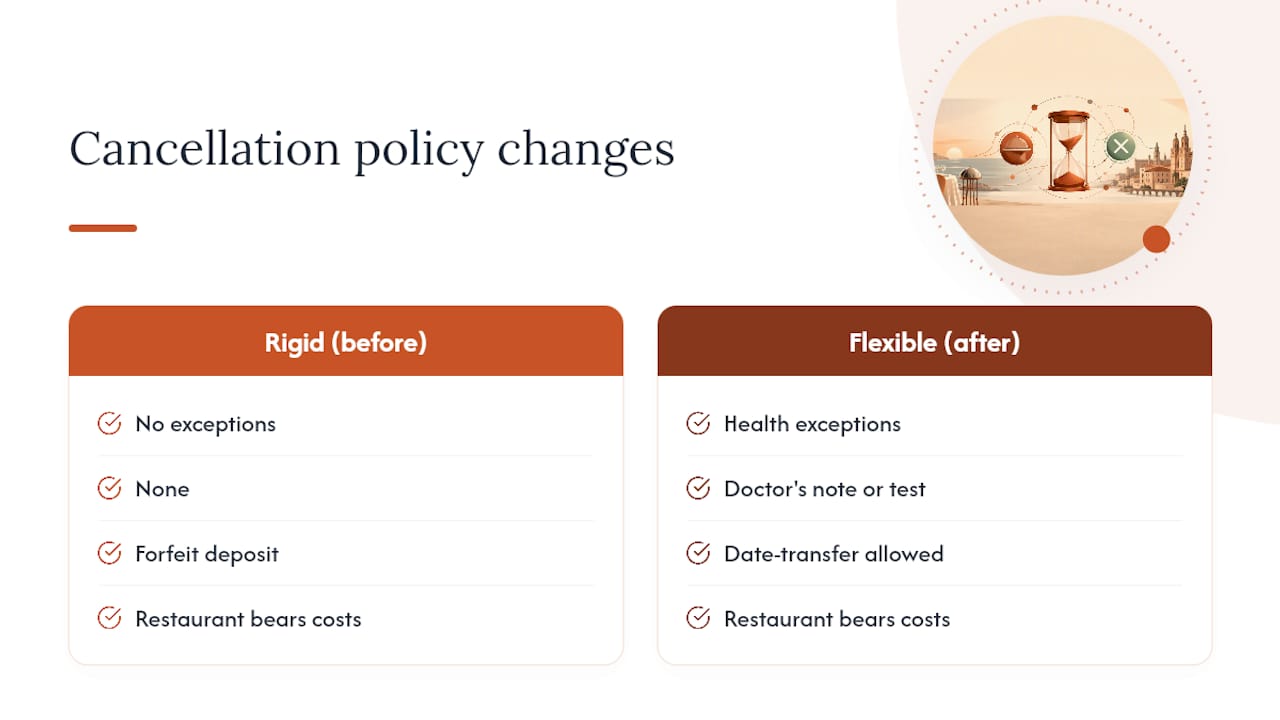
The pandemic left a permanent mark on how fine-dining restaurants write cancellation terms, even years after mandatory closures ended. Restaurants learned the hard way that rigid, no-exceptions policies generate enormous customer resentment when cancellations stem from illness or public health restrictions rather than a diner simply changing plans.
Many restaurants responded by building flexibility into policies for documented health reasons, a doctor’s note, a positive test result, or a household quarantine order, treated differently from a routine change of plans. Some now offer date-transfer options instead of forfeiting a deposit outright: rather than losing your prepayment, you rebook for a later date without penalty.
That flexibility didn’t erase the underlying commercial logic, though. A restaurant still absorbs real costs when a table goes empty regardless of the reason for the cancellation, and fine-dining kitchens with advance ingredient sourcing remain particularly exposed to last-minute changes. What shifted is the tone and the exceptions carved into otherwise strict policies.
The practical lesson for diners booking in 2026: ask specifically whether a restaurant’s policy accounts for illness or emergency circumstances, since this now varies far more between establishments than it did before 2020. A written health-related exception clause is worth confirming at booking, rather than assuming it exists.
How Cancellation Policies Differ Beyond Spain
Cancellation norms shift noticeably once you compare fine dining across borders, and the differences aren’t just cosmetic.
In the United States, many high-end restaurants have moved toward full prepayment models for tasting menus, treating the reservation more like a ticketed event than a table booking, with cancellation terms closer to those of a concert or theater show. In the United Kingdom, deposits are common but typically smaller relative to the total bill, and consumer protection frameworks under UK law require similarly clear disclosure before a fee can be enforced. French fine dining tends to favor telephone confirmation calls a day or two ahead, a practice that reduces no-shows without needing a financial penalty at all.
What stays consistent across markets is the underlying principle: a fee tied to a demonstrable cost and disclosed clearly upfront tends to hold up, wherever the restaurant operates. What varies is the mechanism, prepayment, preauthorization, confirmation calls, and how aggressively local consumer law scrutinizes the amount charged relative to actual loss.
For anyone splitting time between countries or booking a table while traveling, the safest assumption is to read the specific policy in front of you rather than relying on what’s typical back home.
Why Transparency Benefits Both Diners and Restaurants
Clear, proportionate cancellation policies cut disputes and no-shows at the same time, without souring the relationship a restaurant has spent years building with its regulars. A punitive fee might recover one missed seating’s cost, but it also risks the kind of regulatory attention that follows profit-driven charges rather than loss-based ones.
The restaurants that get this right tend to skip the aggressive penalty structure entirely. A simple written policy, a friendly reminder text the day before, and a fair grace period usually prevent more no-shows than a steep fee ever could.
— YellowRock
Reserve a Table at Aflamas
Aflamas gives you a clear path to book without wondering what you’ll be charged if plans change. The tasting menu, signature menu, and seasonal menu are all viewable online before you commit to anything, and the reservation flow shows any deposit or preauthorization requirement alongside the applicable cancellation window before you confirm.
If a deposit applies to your booking, it counts toward your final bill rather than sitting on top of it as an extra charge. That’s the same transparency principle covered throughout this guide, applied directly to how Aflamas runs its own reservations in Barcelona. Group bookings and private dining arrangements get confirmed through direct communication, so any special terms are in writing before your visit rather than left to guesswork on the night. Browse the menus and reserve your table through the tasting menu booking page to see current terms and availability.
Sources
The legal and regulatory claims in this guide draw on primary case law, enforcement actions, and official consumer guidance rather than general commentary.
- La sanción que sacude al sector: el caso de un restaurante madrileño
- Más de 10.000 euros de multa a un restaurante de Madrid por cobrar 100 euros a clientes que no acudían a su reserva
- Un juez avala el cobro de 510 euros a tres personas que no cancelaron su reserva en un restaurante
- Booking conditions and cancellation policy (Junta de Andalucía guidance)
FAQ
What Is a Reasonable Cancellation Policy for Fine Dining?
A reasonable policy discloses its terms clearly before booking, gives a notice window of roughly 24 to 72 hours, and ties any fee to a genuine cost like lost seating or wasted ingredients. Policies that charge amounts disconnected from actual loss risk being challenged as abusive under Spanish consumer protection guidance.
Do You Have to Pay If You Cancel a Restaurant Reservation?
It depends on when you cancel and what you agreed to at booking. If you cancel within the restaurant’s stated free-cancellation window, you typically owe nothing; miss that window after accepting a deposit or preauthorization policy, and the restaurant can generally enforce the charge.
Do I Legally Have to Pay a Cancellation Fee?
You’re legally obligated to pay a cancellation fee when you actively accepted the policy at booking and the fee reflects a real, demonstrable cost to the restaurant. A Spanish court upheld exactly this scenario, ruling in favor of the restaurant because its terms were clearly presented and accepted.
Can a Restaurant Charge You for Cancelling a Reservation?
Yes, a restaurant can charge you for canceling, provided the policy was disclosed before you booked and the amount is proportionate to the restaurant’s actual loss. Fees that appear designed to generate profit rather than cover real costs have led to fines exceeding €10,000 in regulatory enforcement actions.
Does Aflamas Charge a Deposit for Tasting Menu Reservations?
Any deposit or preauthorization requirement at Aflamas is shown directly during the tasting menu reservation flow, along with the applicable cancellation window, before you confirm your booking. Where a deposit applies, it is deducted from the final bill rather than charged as an additional fee.