Tasting menus typically run from roughly sixty-five to three hundred euros or more per person, with the widest gap coming from where a restaurant sits on the Michelin ladder rather than the number of courses on the table. Add roughly €30 to €200 more if you want wine pairings, since pours scale with the ambition of the food. One contemporary restaurant in Barcelona sits in the mid-to-upper tier of that range, which gives you an example benchmark before you book anywhere else.
TL;DR:
- Tasting menu prices vary widely from around 65 to over 300 euros, heavily influenced by the restaurant’s Michelin status and demand.
- Costs for wine pairings can add between 30 and 300 euros, with premium options involving rare vintages or large pours.
- The main expenses stem from labor, sourcing, and capacity constraints, not just ingredients, affecting final pricing across regions.
- Menu duration and course count are closely tied to price tiers, from two-hour bistros to five-hour ultra-premium experiences.
- Comparing menus requires checking total costs, inclusions, and dietary options, not just listed menu prices, to avoid overestimating value.
Table of Contents
- Tasting Menu Price Bands: What the Numbers Actually Mean
- Why Prices Vary: The Real Cost Drivers Behind a Tasting Menu
- How Wine Pairings and Extras Change the Final Bill
- Checklist: How to Compare Tasting Menus and Pick the Right One
- Aflamas: How One Contemporary Tasting Menu Fits the Bands
- Regional Price Variations and Their Causes
- Seasonal Influences on Tasting Menu Pricing
- Author Perspective: Paying for Prestige vs Smart Choices
- Book Aflamas: View Menus, Gift Cards, and Reservations
- Sources
- FAQ
Tasting Menu Price Bands: What the Numbers Actually Mean
A €70 tasting menu and a €280 one aren’t different sizes of the same meal. They’re different products, built on different cost structures, and knowing the band tells you what to expect before the first course arrives.
Restaurants generally fall into three pricing tiers. Entry-level and bistro-style tasting menus run about around sixty to just under one hundred euros, and they’re built around six to eight courses with efficient kitchen turnover. Established fine-dining rooms, often holding one or two Michelin stars, price between between roughly one hundred and just under two hundred euros, using a heuristic where the menu price lands at approximately three and a half to four times the raw ingredient cost per plate, according to HappyChef’s restaurant strategy guide. Haute cuisine and three-star houses start around €195 and frequently clear €295 or higher, before any pairing gets added.
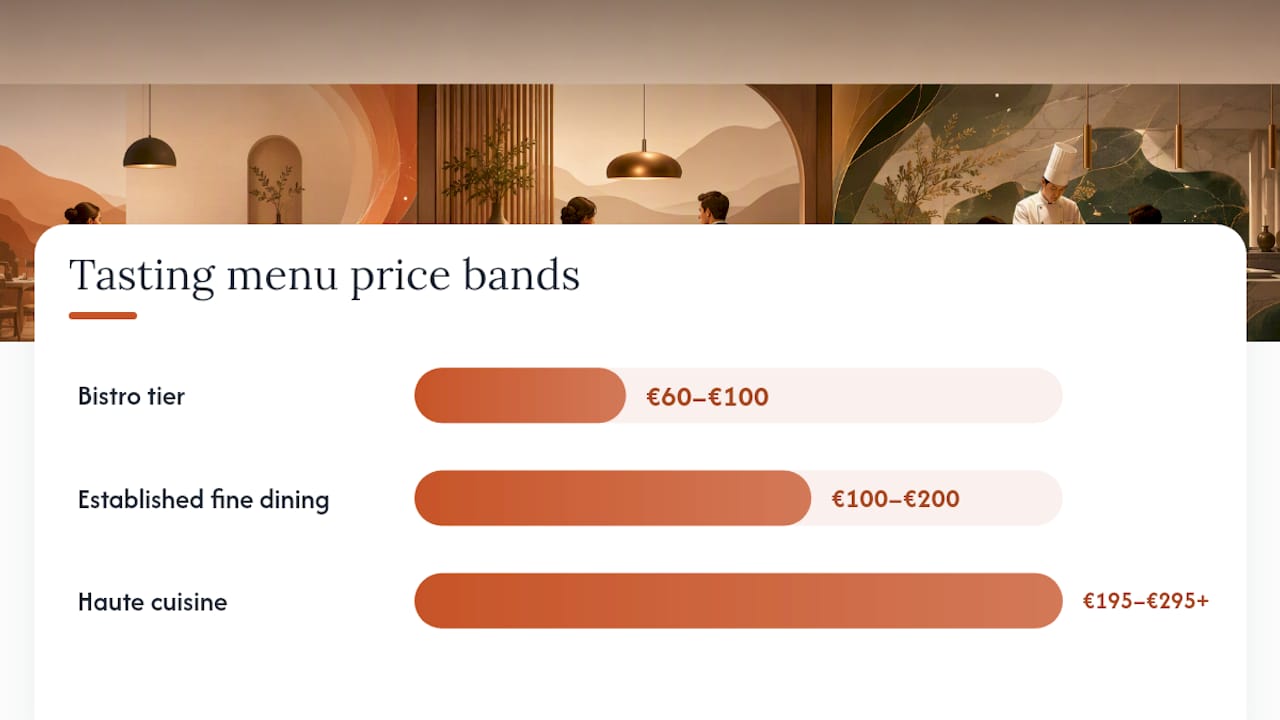
These figures cover the food alone. Wine, water, coffee, and service are usually separate line items unless the menu explicitly says “included.”
Course counts and timing track the price band closely:
- Bistro tier: six to eight courses, roughly about two to two and a half hours at the table
- Established fine dining: eight to ten courses, around three hours, per typical tasting menu duration norms
- Haute cuisine and ultra-premium: 10 to 12 courses or more, often between three and five hours with theatrical pacing
Real menu pages back this up. Roundups of Spanish Michelin-starred dining show entries under €60 in Barcelona at the casual end, a thick cluster of fine-dining menus between €150 and €300, and top-tier destinations pushing past €300 once you count everything on the table, according to Bonviveur’s pricing survey. At the very top, reporting on restaurants like DiverXO shows total per-person spend climbing into the high hundreds once premium pairings and add-ons stack on top of the base price, per coverage in El Confidencial Digital.
Why Prices Vary: The Real Cost Drivers Behind a Tasting Menu
Ingredients are rarely the biggest line item. Labor, sourcing relationships, and the sheer inefficiency of running a kitchen at that level of precision usually cost more than the food itself.
Pricing consultancies like Masterestaurant recommend a method that flips the usual math: instead of adding up costs and tacking on margin, a restaurant first benchmarks what the market will actually pay, then works backward to hit a food-cost target, generally somewhere between a food-cost target generally between a quarter and a third of the menu price depending on the segment, according to Masterestaurant’s pricing statistics. That’s the opposite of cost-plus pricing, and it’s why two restaurants using nearly identical ingredients can charge wildly different amounts.
Food-cost benchmark: Most tasting-menu operators aim to keep raw ingredient costs at 26 to 31 percent of the final menu price, letting labor, overhead, and margin absorb the rest.
Scarcity does the rest of the work. A dining room with 20 seats a night can’t spread fixed costs the way a 100-seat restaurant can, so each seat has to carry more weight. Chef Quique Dacosta has been direct about this: he’s said the staffing and premium raw materials behind his 295 euro tasting menu leave him no room to charge less, describing it as a structural reality of running a kitchen at that level, per Cadena SER’s interview. Reputation and demand push prices further still. Coverage of price hikes at destination restaurants shows menus climbing year over year simply because demand outpaces the number of tables available, according to reporting on pricing variables.
How Wine Pairings and Extras Change the Final Bill
The menu price is rarely the number you’ll actually pay.
Wine pairings scale with the ambition of the food:
- Mid-tier pairings: about thirty to three-quarters of a hundred euros for a matched flight of five to eight wines
- Top-tier or reserve pairings: from one and a half to three hundred euros or more, especially when rare vintages or large-format pours are involved
- Premium single dishes: many kitchens offer an optional supplement (think caviar service or a larger cut of a signature protein) that adds anywhere from fifteen to eighty euros to an individual course
- Service and gratuity: some rooms build a service charge into the bill; others leave it optional, so it’s worth asking before you sit down
Here’s a worked example. A fine-dining menu priced at a menu priced around one hundred forty euros with mid-tier pairing and some premium supplements brings your real per-person total to €220, before tax or tip.
Checklist: How to Compare Tasting Menus and Pick the Right One
Comparing two tasting menus by price alone is like comparing two flights by ticket cost without checking the layovers. Run through this before you book:
- Confirm the total price, not just the menu price. Ask whether tax, service, and gratuity are included.
- Check the course count and duration. A 12-course, 4-hour menu and an 8-course, 2-hour one aren’t interchangeable, even at similar prices.
- Ask if pairing is included or optional, and get the price for both the standard and premium pairing flights.
- Confirm dietary flexibility. Because many components are prepared well in advance, allergies and restrictions need to be flagged at booking, not at the table.
- Ask about seating format and timing. Communal counters, private tables, and open-kitchen seats all change the experience at the same price point.
- Get the cancellation and prepayment policy in writing. High-demand restaurants often require a deposit or full prepayment.
Beyond the checklist, look for softer value signals: a named sommelier on staff, sourcing notes on the menu itself, or recent press and awards. None of these guarantee quality, but their absence is worth noticing.
Pro Tip: Call or email the restaurant directly and ask two questions: “Is the pairing mandatory?” and “What’s included in the stated price?” You’ll get a clearer answer than any online menu page provides.
Aflamas: How One Contemporary Tasting Menu Fits the Bands
One restaurant in Barcelona runs a chef-driven tasting menu built around fire-based cooking techniques and local ingredients, with full accommodations for vegetarian, vegan, gluten-free, and lactose-free diners. That combination of a compact, technique-driven menu and flexible dietary handling places it comfortably in the established fine-dining band described above, the tier built for a special dinner rather than a quick bite.
- The signature menu offers a more concentrated, chef-forward version for guests who want the kitchen’s boldest expression in fewer courses.
- Group and private events run through a separate group menu built for parties and celebrations.
- Gift cards are available for anyone who wants to give the experience rather than book it themselves.
Regional Price Variations and Their Causes
A tasting menu in a small provincial city and the same concept in Madrid or Barcelona rarely cost the same, even with comparable technique and ingredients. Rent is the obvious driver. A restaurant paying premium commercial rent in a capital’s dining district has to recover that overhead somewhere, and the menu price is where it lands.
Labor markets matter just as much. Cities with a deep bench of trained kitchen staff and sommeliers tend to see wages, and therefore menu prices, run higher than regions where that talent pool is thinner and harder to retain. Tourism density plays a role too: destination cities with heavy international visitor traffic can sustain higher prices because a large share of diners are booking a once-a-trip experience rather than a regular local outing, and they’re less price-sensitive as a result.
Ingredient sourcing adds another layer. A restaurant near a coast or a producing region pays less to secure premium seafood, produce, or game than one that has to ship it in. That logistics gap shows up directly in the food-cost side of the pricing equation, even before staffing or rent enter the picture.
None of this means a cheaper region equals a lesser meal. It means the price reflects local economics as much as culinary ambition, and comparing menus across cities without accounting for that context will give you a distorted sense of value.
Seasonal Influences on Tasting Menu Pricing
Menu prices shift with the calendar more than most diners assume, and it’s rarely random. Peak dining seasons, holiday weeks, and major local events routinely see higher prices or added supplements, since demand for a limited number of seats spikes while capacity stays fixed.
Ingredient seasonality pulls in the other direction sometimes, and other times pushes prices up. A menu built around a short-season delicacy, wild mushrooms, a particular seafood run, or early-harvest produce, often carries a premium simply because that ingredient is expensive and fleeting. Kitchens that lean into true seasonality tend to rotate their tasting menus several times a year, and each rotation can shift the price slightly as the ingredient list changes.
Broader cost pressure across the industry has also nudged prices upward in recent years. Rising costs tied to energy, imported goods, and specialized labor have squeezed margins across the hospitality sector, a trend explored in Wild Foodz’s rundown of pressures facing chefs. That’s less a seasonal effect and more a structural one, but it compounds with seasonal demand spikes to make certain months of the year consistently pricier than others.
The practical takeaway: if you’re flexible on timing, booking outside peak weeks or major local festivals can shave real money off the bill, especially at restaurants that adjust pricing around demand rather than holding a fixed menu price year round.
Author Perspective: Paying for Prestige vs Smart Choices
A three-figure tasting menu earns its price when the moment justifies it: an anniversary, a once-a-year splurge, a chef’s tasting you’ve wanted for years. For a regular night out, a well-run bistro tasting menu in the €70 to €95 range often delivers more genuine satisfaction per euro than a middling fine-dining room padding its price on reputation alone. Book early, flag dietary needs immediately, and don’t confuse a high price with a guaranteed better night.
— YellowRock
Book Aflamas: View Menus, Gift Cards, and Reservations
This restaurant gives diners a fixed, transparent price point instead of the guesswork that comes with comparing menu pages across a dozen unfamiliar restaurants. It builds its menus around fire-based cooking and locally sourced ingredients, with full dietary accommodation integrated rather than bolted on as an afterthought.
Start with the tasting menu for a full multi-course arc, or check the signature menu if you want the kitchen’s most concentrated statement. Planning something larger? The group and private-dining option handles celebrations and events directly, and gift cards are available if you’d rather give the experience than book it yourself. Reserve your date now and confirm any dietary needs at the time of booking.
Sources
- Así cambia (y dispara) el precio de DiverXO
- Precio menú degustación: método MR vs tradicional · Estadísticas
- Crear un Menú Degustación: 7 Pasos hacia Más Margen (Guía 2026) | HappyChef
- Quique Dacosta explica por qué el menú degustación de su restaurante cuesta 295 euros y no puede costar menos | Cadena SER
FAQ
What Does a Tasting Menu Typically Include?
A tasting menu is a fixed sequence of small courses, usually 6 to 12, designed to showcase a chef’s range and technique in one sitting, with wine pairing typically offered as a separate add-on rather than built into the base price.
How Much Does Dinner Typically Cost in Spain?
A standard restaurant dinner in Spain runs far below tasting-menu prices, but a dedicated tasting-menu experience spans roughly €65 at the bistro level up to €295 or more at haute-cuisine restaurants, before any wine pairing is added.
What Is the Most Expensive Tasting Menu in the World?
Ultra-premium tasting menus at destination restaurants like DiverXO can push total per-person costs into the high hundreds of euros once premium pairings and extras are included, though the exact ceiling shifts as top kitchens revise pricing year to year.
Is a Higher Price Always a Sign of a Better Tasting Menu?
Not necessarily. Price reflects staffing, sourcing, seat scarcity, and reputation as much as it reflects the food itself, so a well-run bistro-tier menu can deliver comparable satisfaction to a much pricier haute-cuisine room.
Does Aflamas Offer Options for Dietary Restrictions?
Yes. Aflamas accommodates vegetarian, vegan, gluten-free, and lactose-free diets, and dietary needs should be flagged at the time of booking the tasting menu since many components are prepared in advance.