A pescatarian eats fish and seafood alongside plants; a vegetarian excludes all animal flesh. That single difference changes more than any other: pescatarians get EPA, DHA, and vitamin D straight from food, while vegetarians need to plan harder around those three nutrients. Neither diet is automatically healthier. Both work well when built around whole foods rather than processed substitutes.
TL;DR:
- Pescatarians can more easily meet omega-3 and vitamin D requirements through fish consumption, while vegetarians rely on supplements or fortified foods.
- Both diets are associated with modest reductions in cancer and heart disease risks, but these benefits are influenced by overall lifestyle and not solely diet.
- Nutrient deficiencies in vegetarian and pescatarian diets often involve B12, vitamin D, iodine, and omega-3s, requiring careful planning and regular testing.
- Pescatarian groceries tend to cost more due to fresh fish, and cooking fish requires more skill compared to shelf-stable plant foods.
- Environmental and ethical impacts depend heavily on sourcing practices and choices of seafood species, with sustainable options significantly reducing ecological footprints.
Table of Contents
- Pescatarian vs Vegetarian: The Basics on Each Diet
- Similarities and Differences Between Pescatarian and Vegetarian Diets
- What Does the Health Evidence Actually Show?
- Nutrient Risks and How to Plan Around Them
- Environmental and Ethical Considerations
- Eating Out and Restaurant Adaptations
- Which Should I Choose: Pescatarian or Vegetarian?
- Our Take on the Pescatarian vs Vegetarian Debate
- Sources
Pescatarian vs Vegetarian: The Basics on Each Diet
The confusion around these two diets usually comes down to sloppy labeling, not the diets themselves. A pescatarian follows a plant-heavy diet that also includes fish and shellfish but no other meat, poultry, or land animal products beyond what a lacto-ovo vegetarian already eats. A vegetarian eats no flesh at all, fish included, though the term covers several distinct sub-patterns that get lumped together far too often.
Lacto-ovo vegetarians eat both eggs and dairy alongside plants, and they represent the most common vegetarian pattern in Western countries. Ovo-vegetarians eat eggs but skip dairy. Lacto-vegetarians eat dairy but skip eggs. Flexitarians eat mostly plants but allow occasional meat, which technically makes them omnivores with a strong plant lean, not vegetarians at all. Pescatarians sit in their own category: vegetarian in spirit, but with fish and seafood added back in for flavor, nutrition, or convenience.
Here’s where it gets messier. Research on self-identified vegetarians has found that a meaningful share of people who call themselves vegetarian still eat fish occasionally, which muddies both survey data and restaurant communication. If you tell a server you’re “basically vegetarian but I eat fish,” you’re describing a pescatarian, and saying so directly avoids a kitchen accidentally serving you a beef consommé reduction or a dish finished with fish sauce.
What a day of eating looks like on each diet
Pescatarian sample day:
- Breakfast: Greek yogurt with walnuts and berries, or eggs with sautéed spinach
- Lunch: Grilled salmon salad with olive oil, chickpeas, and roasted vegetables
- Dinner: Seared branzino with white beans, garlic, and lemon, plus a side of greens
Vegetarian sample day:
- Breakfast: Oatmeal with peanut butter, chia seeds, and sliced banana
- Lunch: Lentil soup with whole grain bread and a side salad with feta
- Dinner: Stir-fried tofu with broccoli, brown rice, and a sesame-ginger sauce
Both days hit reasonable protein and fiber targets. The pescatarian day pulls ahead on omega-3 fats and vitamin D, almost entirely because of the fish. That gap, not calorie count or “healthiness” in the abstract, is the real story of how these two diets diverge in practice
Similarities and Differences Between Pescatarian and Vegetarian Diets
Both diets share the same foundation: vegetables, fruits, whole grains, legumes, and nuts make up the bulk of daily calories. Both diets exclude poultry, beef, pork, and lamb. Both diets tend to produce diets higher in fiber and lower in saturated fat than the standard Western pattern, which is a large part of why researchers group them together in cohort studies in the first place.
The differences start once fish enters (or stays out of) the picture.
Omega-3 fatty acids. Fatty fish like salmon, sardines, and mackerel are the most efficient dietary source of EPA and DHA, the long-chain omega-3s tied to cardiovascular and cognitive health. Vegetarians rely on ALA from flaxseed, walnuts, and chia, which the body converts to EPA and DHA at a notoriously low rate, often in the single digits percentage-wise. A modeling study of USDA food patterns found that adding seafood to a vegetarian-style pattern meaningfully increased EPA/DHA, vitamin D, and choline intake compared with a lacto-vegetarian model, closing nutrient gaps that plant sources alone struggle to fill.
Vitamin D. Fatty fish is one of the few naturally occurring dietary sources of vitamin D. Vegetarians depend almost entirely on fortified foods (milk, plant milks, some cereals) or sun exposure, which varies by latitude and season and isn’t a reliable year-round strategy for most people.
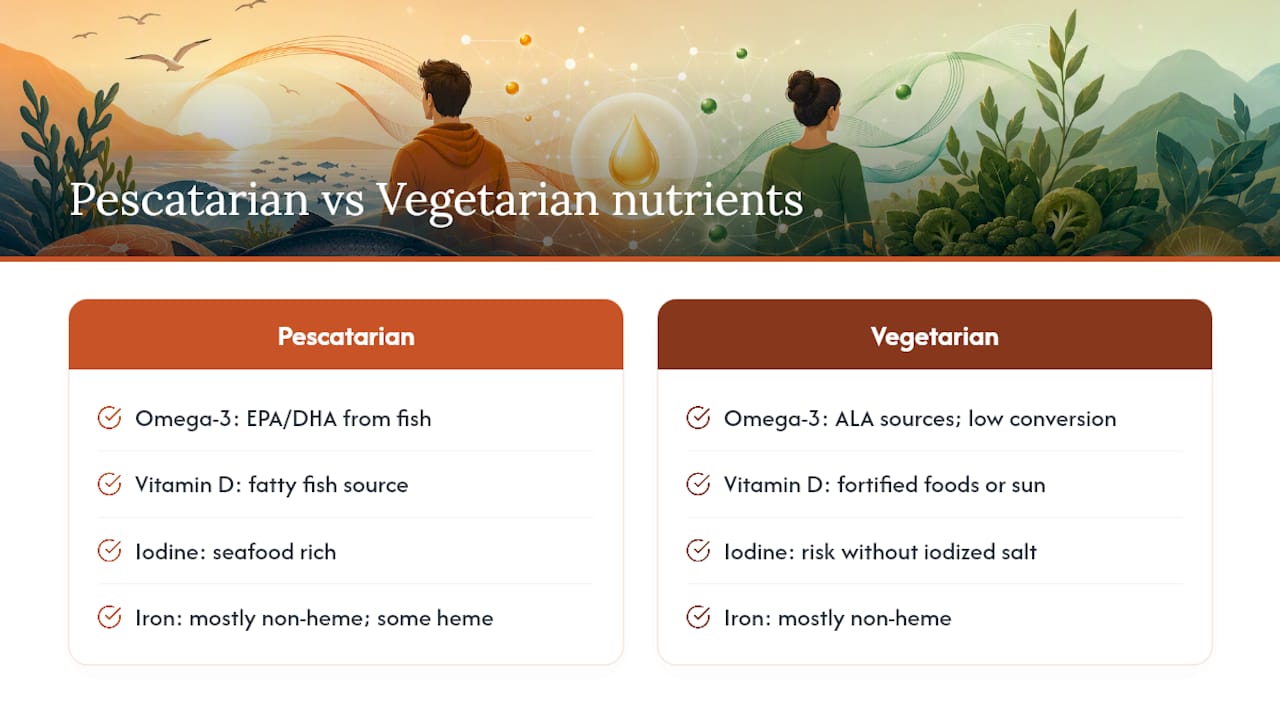
Iodine. Seafood is naturally rich in iodine, an often-overlooked nutrient tied to thyroid function. Vegetarians who don’t use iodized salt or eat dairy regularly can run low, since plant foods are inconsistent iodine sources depending on soil content.
Iron type. Both diets get most of their iron from non-heme sources (beans, spinach, fortified cereals), which absorbs less efficiently than the heme iron in meat. Fish contains some heme iron, giving pescatarians a modest edge here, though the gap is smaller than with omega-3s or vitamin D.
Calcium. This one’s roughly a wash. Both diets can hit calcium targets through dairy, fortified plant milks, tofu made with calcium sulfate, and leafy greens, assuming the diet isn’t heavily restricted beyond excluding meat and fish.
On the practical side, pescatarian grocery shopping tends to cost more. Fresh fish, particularly wild-caught varieties, runs higher per pound than dried beans or seasonal produce, and it spoils faster, which means more frequent shopping trips. Vegetarian staples like lentils, rice, and canned tomatoes store for months and cost a fraction of the price. Cooking skill matters too: fish is less forgiving of overcooking than a pot of beans, so pescatarians often face a steeper early learning curve in the kitchen.
What Does the Health Evidence Actually Show?
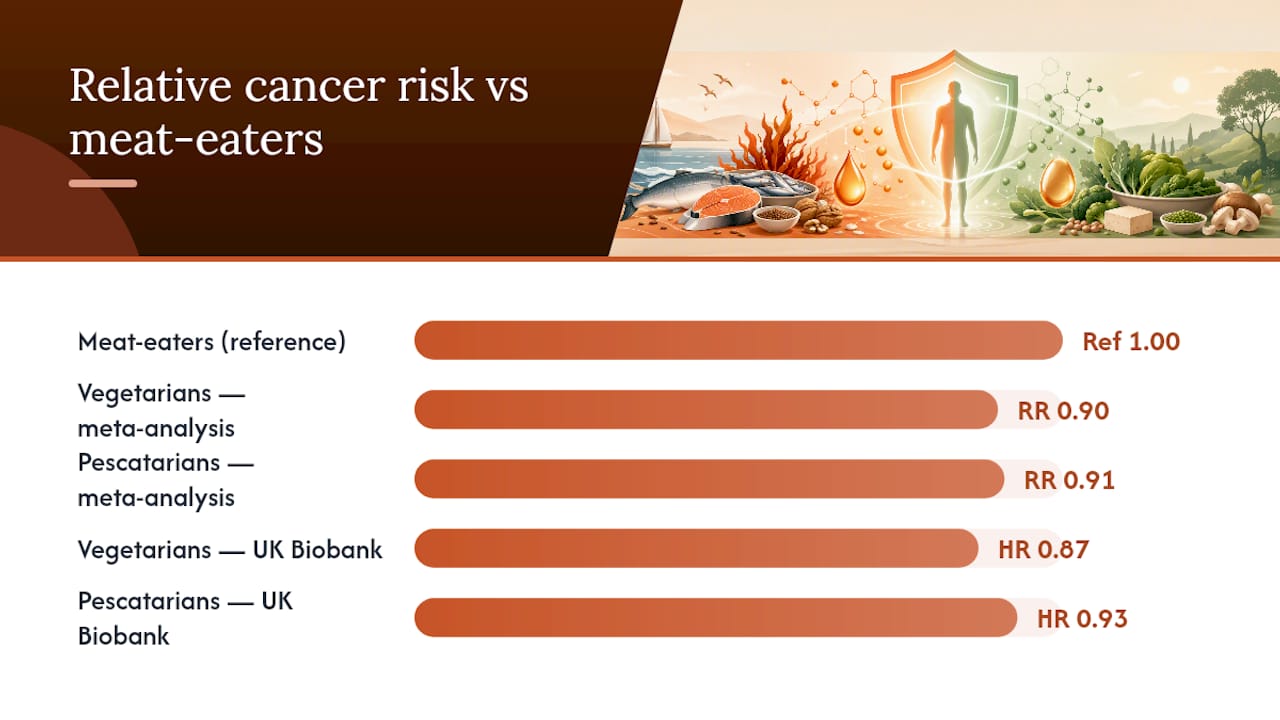
The most cited figure in this comparison comes from a UK Biobank prospective cohort study and meta-analysis covering nearly half a million adults, which found vegetarians had lower overall cancer risk (HR 0.87, 95% CI 0.79–0.96) and pescatarians had a modestly lower risk (HR 0.93, 95% CI 0.87–1.00) compared with regular meat-eaters. Pooling that cohort with other studies in meta-analysis showed a relative risk around 0.90 for vegetarians and 0.91 for pescatarians on overall cancer, both statistically meaningful but modest in absolute terms.
The numbers, in context: A relative risk of 0.90 doesn’t mean vegetarians face a 10% chance of avoiding cancer altogether. It means their relative risk compared with meat-eaters in the same study population dropped by roughly a tenth, a real but incremental effect that stacks on top of dozens of other lifestyle and genetic factors.
Colorectal cancer showed one of the clearer patterns: vegetarians had a lower risk, and pescatarians landed close behind, likely reflecting the well-documented link between high red and processed meat intake and colorectal cancer risk. Prostate cancer risk dropped more distinctly among vegetarians specifically.
Cardiometabolic outcomes tell a similar story of modest, consistent advantage rather than dramatic transformation. The EPIC-Oxford cohort found vegetarians and vegans had noticeably lower BMI, LDL cholesterol, and blood pressure than meat-eaters, alongside roughly 22% lower ischemic heart disease risk in the combined plant-based group. That same analysis flagged a trade-off worth knowing about: vegetarians in some cohorts showed lower bone density and a higher risk of hemorrhagic stroke, a reminder that no dietary pattern is a free lunch on every outcome.
A repeated cross-sectional study from Geneva spanning 2005 to 2017 backed this up at the population level, finding vegetarians and pescatarians had lower BMI, total cholesterol, and rates of hypertension than omnivores. But the researchers were careful to note that BMI itself mediates much of the cardiovascular benefit. People who adopt these diets often also exercise more, smoke less, and drink less, which makes isolating the diet’s independent effect genuinely hard.
That’s the core caveat running through nearly all of this evidence: it’s observational, not experimental. Nobody randomized thousands of people to eat meat or not eat meat for twenty years and tracked outcomes in a controlled trial. Cohort studies follow people who already chose their diets, which means healthier, more health-conscious individuals may simply be more likely to go vegetarian or pescatarian in the first place. Researchers adjust statistically for smoking, exercise, income, and education, but residual confounding, the stuff that adjustment can’t fully strip out, never disappears completely.
What this means practically: expect a real but modest reduction in certain cancer and cardiovascular risks from either diet, not a guarantee, and not a reason to skip screenings or medical checkups. The size of the benefit looks similar enough between pescatarians and vegetarians that the choice between them should hinge more on personal goals, ethics, and practicality than on chasing a marginal statistical edge one direction or the other.
Nutrient Risks and How to Plan Around Them
Cross-sectional survey data on semi-vegetarian and vegetarian adults consistently flags protein and omega-3 shortfalls as recurring problems, especially among people who reduce meat without deliberately replacing the nutrients meat used to provide. The fix isn’t complicated, but it does require attention.
- Vitamin B12. Found almost exclusively in animal products, including fish, eggs, and dairy. Strict vegetarians who eat enough eggs and dairy usually cover it; anyone eating fewer animal products should get levels checked annually and consider a supplement in the 250 to 500 microgram range.
- Vitamin D. Test levels once a year, particularly in fall and winter. Fortified plant milks, fortified cereals, and egg yolks help; a daily supplement of 600 to 800 IU is common guidance for adults who don’t get regular sun exposure. The NHS nutrition guidance recommends everyone consider a vitamin D supplement during autumn and winter regardless of diet.
- Iodine. Use iodized salt consistently, since sea salt and kosher salt typically aren’t iodized. Dairy and eggs help too. Vegetarians who avoid both dairy and iodized salt are at the highest risk of falling short.
- Iron. Pair plant iron sources (lentils, spinach, fortified cereal) with vitamin C-rich foods like citrus or bell peppers to boost absorption. Get ferritin checked if you notice fatigue, especially if you menstruate.
- EPA and DHA. Vegetarians can’t get these from fish, so algae oil supplements are the most reliable plant-based source, typically delivering 200 to 300 mg combined EPA/DHA per dose. Pescatarians should aim for two servings of fatty fish weekly, which covers most adults’ needs without a supplement.
Pro Tip: Don’t wait for a symptom to check B12 or vitamin D. Both deficiencies build slowly and quietly, often showing up as fatigue or brain fog long before a blood test would have caught them early. An annual panel costs far less than the months of feeling run down while you figure out why.
A practical seven-day shopping list for either diet should include: dark leafy greens, a legume variety (lentils, chickpeas, black beans), a whole grain (quinoa, farro, brown rice), fortified plant milk or dairy, nuts and seeds (walnuts, chia, flax), eggs if not strictly vegan-leaning, iodized salt, and for pescatarians, two portions of fatty fish. Track intake loosely against these five markers monthly: energy levels, iron-rich food frequency, omega-3 source frequency, dairy or fortified-alternative intake, and whether a B12 or vitamin D supplement has actually made it into the routine rather than just the cabinet.
Anyone who is pregnant, breastfeeding, training at a competitive athletic level, or managing a chronic condition should treat this checklist as a starting point, not a replacement for personalized guidance from a registered dietitian. Energy and iron needs shift substantially in those situations, and generic advice can undershoot what the body actually requires.
Environmental and Ethical Considerations
Plant-based diets generally carry a smaller carbon and land footprint than diets built around animal protein, a pattern that holds broadly across most global food-system research. Where it gets more nuanced is inside the pescatarian category itself: seafood’s environmental footprint swings wildly depending on species and catch method. Farmed bivalves like mussels and oysters can have a footprint close to vegetables. Bottom-trawled or long-distance flown-in fish can rival red meat in some impact categories.
Ethically, the calculation looks different for different people. Some vegetarians avoid fish specifically because they extend the same welfare concerns to aquatic animals that they apply to land animals. Some pescatarians draw the ethical line differently, reasoning that wild-caught fish live outside intensive farming systems, or that fish populations don’t raise the same sentience concerns for them that mammals and birds do. Neither position is objectively correct; they reflect different values, not different facts.
For anyone leaning pescatarian for sustainability reasons, a few sourcing habits make a real difference:
- Favor smaller, lower-trophic species (sardines, mackerel, anchovies) over large predatory fish, which tend to carry a heavier ecological and mercury footprint.
- Look for certified sustainable labels from recognized seafood certification programs when shopping or ordering.
- Choose farmed shellfish and mollusks over farmed carnivorous fish, since bivalves filter water rather than requiring feed input.
- Ask where wild-caught fish comes from. Local, small-boat catch generally has a lighter footprint than fish flown across continents.
Eating Out and Restaurant Adaptations
Restaurant menus rarely spell out every ingredient, and that’s where most accidental slip-ups happen. Fish sauce hides in Southeast Asian dressings. Chicken stock quietly flavors “vegetable” soups. Gelatin, made from animal collagen, turns up in desserts and thickened sauces without warning. The single most useful habit for either diet is asking directly: “Is there any fish sauce, stock, or gelatin in this dish?” rather than trusting the menu description alone.
Good kitchens expect this question and have answers ready. A well-run kitchen typically has at least one flexible course built around vegetables, grains, or legumes that can flex into a vegetarian or pescatarian version without disrupting the rest of the menu’s flow, whether that means swapping a meat-based protein for a seafood-forward alternative or leaning further into a vegetable-driven composition. A thoughtfully built seasonal menu built around what’s in season, rather than default meat substitutes, tends to serve every dietary pattern better than a one-size-fits-all substitution.
Tasting menus are planned with this flexibility built in from the start rather than bolted on as an afterthought. Seasonal courses built around fire-cooked technique and local produce lend themselves naturally to a vegetarian route, and the same menu structure accommodates a pescatarian path by leaning into seafood courses instead of substituting a plant protein for meat. The tasting menu is designed with vegetarian, vegan, gluten-free, and lactose-free adaptations available, so a table with mixed dietary preferences doesn’t need to negotiate around a single fixed menu. For groups planning a private event, the group menu format extends that same flexibility across a full party rather than accommodating one dietary need at a time.
Quick checklist before you sit down anywhere:
- Say the diet plainly: “I eat fish but no other meat” is clearer than “mostly vegetarian.”
- Ask about stock, sauce bases, and gelatin specifically, not just the obvious protein.
- Confirm whether a vegetarian dish is also vegan, since cheese, cream, and eggs vary by kitchen.
- For tasting menus, ask if the whole sequence can be adapted or just individual courses.
Which Should I Choose: Pescatarian or Vegetarian?
The right answer depends less on health statistics, which land close enough between the two diets to be a tiebreaker at best, and more on what’s actually driving the decision.
- If health is the primary goal and you’re comfortable eating fish, pescatarian is the easier path to hitting omega-3 and vitamin D targets without heavy reliance on supplements.
- If animal welfare across all species is the driving motivation, vegetarian (or further toward vegan) aligns more directly with that value than pescatarian does.
- If convenience and cost matter most, vegetarian staples like legumes and grains are cheaper and more shelf-stable than fresh fish, making vegetarian easier to sustain on a tight budget or unpredictable schedule.
- If sustainability is the main concern, the answer depends on specifics: a vegetarian diet built on shelf-stable plant staples generally beats a pescatarian diet built on flown-in predatory fish, but a pescatarian diet centered on local bivalves and small fish can rival or beat a heavily processed vegetarian diet.
Anyone pregnant, breastfeeding, managing diabetes, training at a competitive athletic level, or navigating a diagnosed nutrient deficiency should loop in a doctor or registered dietitian before committing to either pattern long-term. Generic guidance covers most healthy adults well; it doesn’t account for elevated iron needs in pregnancy or the higher protein demands of serious athletic training.
For anyone still undecided, a one-month trial beats months of overthinking. Pick one diet, track energy levels weekly, and get a basic blood panel (B12, vitamin D, ferritin) at the start and again at the two-month mark. If numbers hold steady and energy feels normal, the diet is working. If something drifts, that’s the specific nutrient to address, not a signal to abandon the whole approach.
Our Take on the Pescatarian vs Vegetarian Debate
The evidence doesn’t crown a clear winner, and that’s the actual finding worth sitting with. Cancer and cardiovascular risk reductions land in a similar modest range for both diets, which means the health argument for choosing one over the other is weaker than most diet content implies.
Where conventional advice falls short is treating “vegetarian” and “pescatarian” as health verdicts rather than food frameworks. A vegetarian diet built on fried snacks and refined carbs isn’t healthier than a pescatarian diet built on grilled fish and vegetables, and plenty of research on processed plant foods backs that up. The label matters far less than what actually lands on the plate.
If there’s one priority to fix first, it’s nutrient testing, not menu planning. Get a baseline B12 and vitamin D check before overhauling anything. That single step catches the shortfalls that cause the most real-world fatigue and frustration, long before a shopping list or a restaurant order ever will.
— YellowRock
This article is general information, not a substitute for advice from a qualified doctor. Consult a qualified healthcare professional about your own circumstances before acting on anything here.